








Colmar in Winter: Where Teddy Bears Outnumber Reality

https://markyourlandingspot.com/wp-content/uploads/2026/01/Colmar-in_winter_France_0004-1.jpg
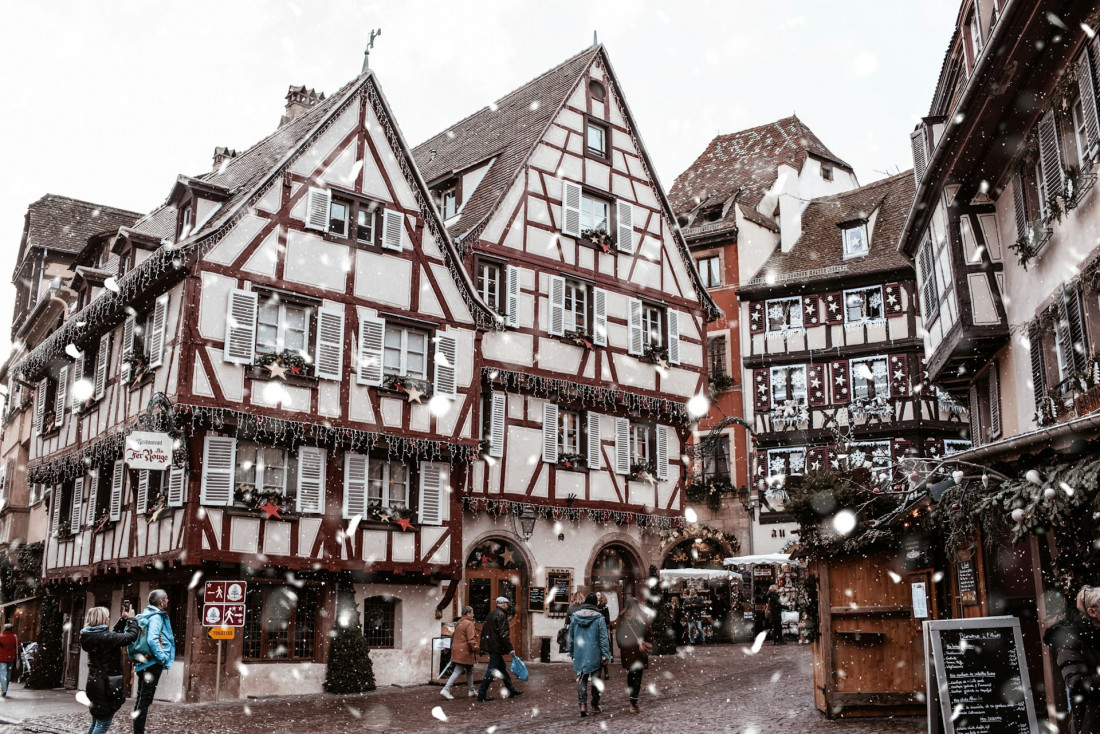
Colmar in winter: half-timbered houses on a snowy square in the historic centre

Colmar in winter is not a town — it’s a perfectly staged set. By the end of the day, teddy bears outnumber reality.


I knew Colmar, in eastern France, almost entirely from summer postcards: flowers spilling over balconies, canals edged with pastel façades. Colmar in winter existed only as a reputation — one of the most aggressively Christmassy towns in France.

I went on 30 December to see what happens when the festive illusion should, in theory, begin to thin out.

It didn’t.

Teddy bears take over

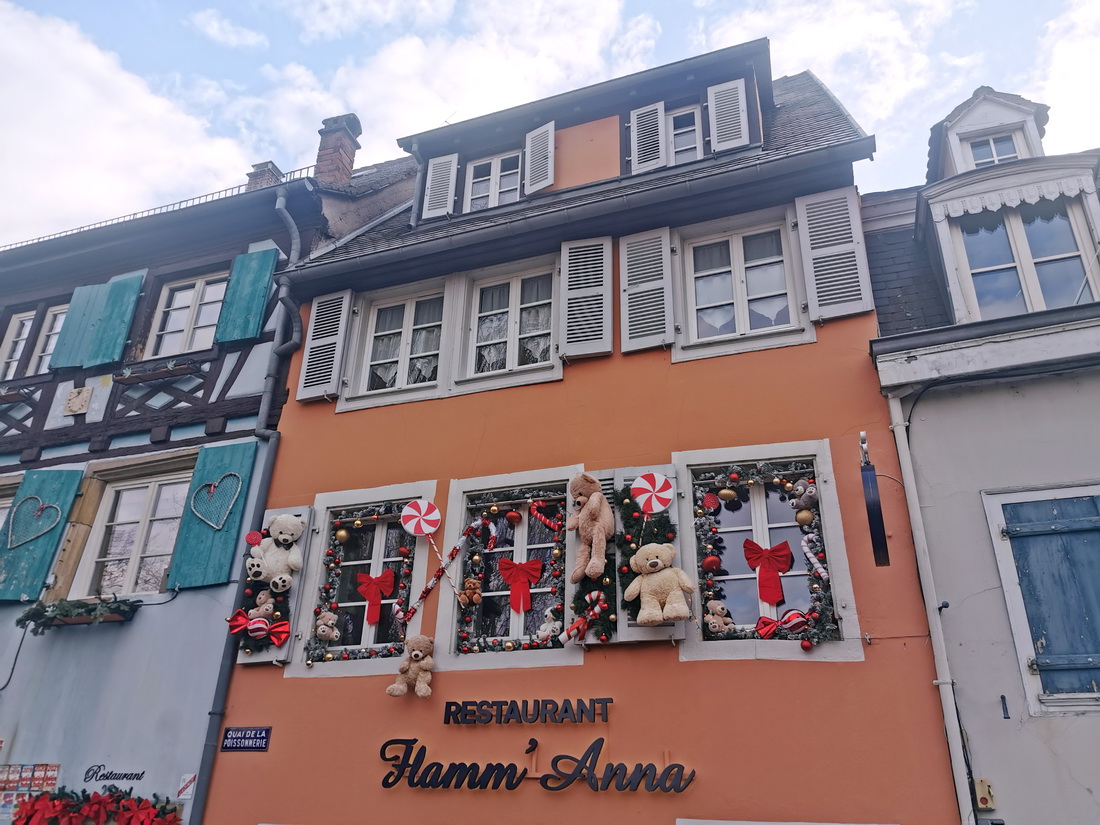
Teddy bear Christmas decorations on house facade in Colmar winter

In Colmar, even the façades join the performance.

For about twenty minutes from the station, nothing happens.

Ordinary streets. Normal pace. No sparkle. Just enough time to wonder whether the fairy tale is mostly marketing.

Then you reach Little Venice — and the pattern starts to show.

At first, it’s discreet.
One bear in a window.
Another above a door.

Easy to miss. Easy to dismiss.

A few steps later, there are more. Sitting. Hanging. Tucked into wreaths. Balanced on ledges. Framed by shutters. Reappearing where you’ve already looked.

Plush bears. Wooden bears. Drawn bears. Bears in scarves. Bears in identical poses, repeated with small variations.

In windows. On balconies. Above doors. Across façades.

You stop counting. Not because there are too many — but because counting stops making sense. The repetition does the work.

There are trees, snowmen, garlands. All the expected things. But they feel secondary. The bears hold the composition together, quietly linking one street to the next.

At some point, you realise you’re no longer looking for anything. Your eyes slide over details without settling. The street reads as a whole, already complete.

That’s when cosiness stops being an atmosphere and starts behaving like infrastructure.

When everything starts to look the same
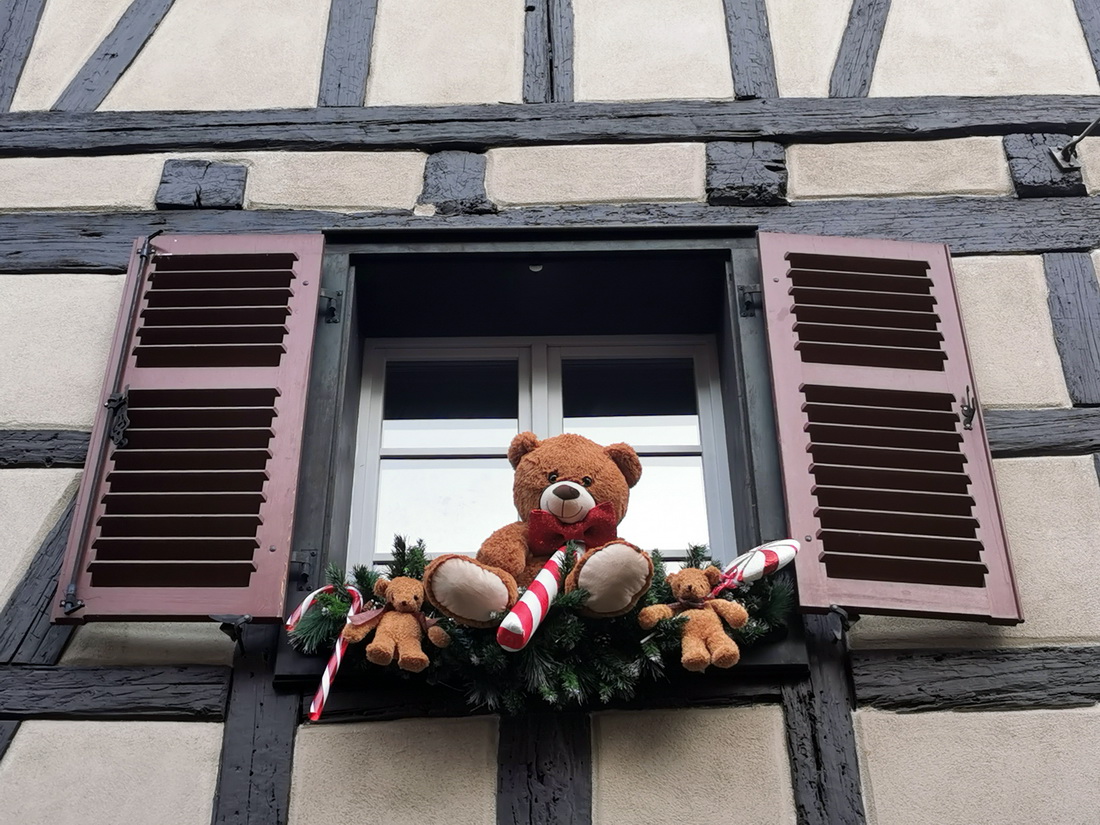
Teddy bear Christmas decoration in Colmar old town window

This is how the motif repeats itself — quietly, relentlessly.
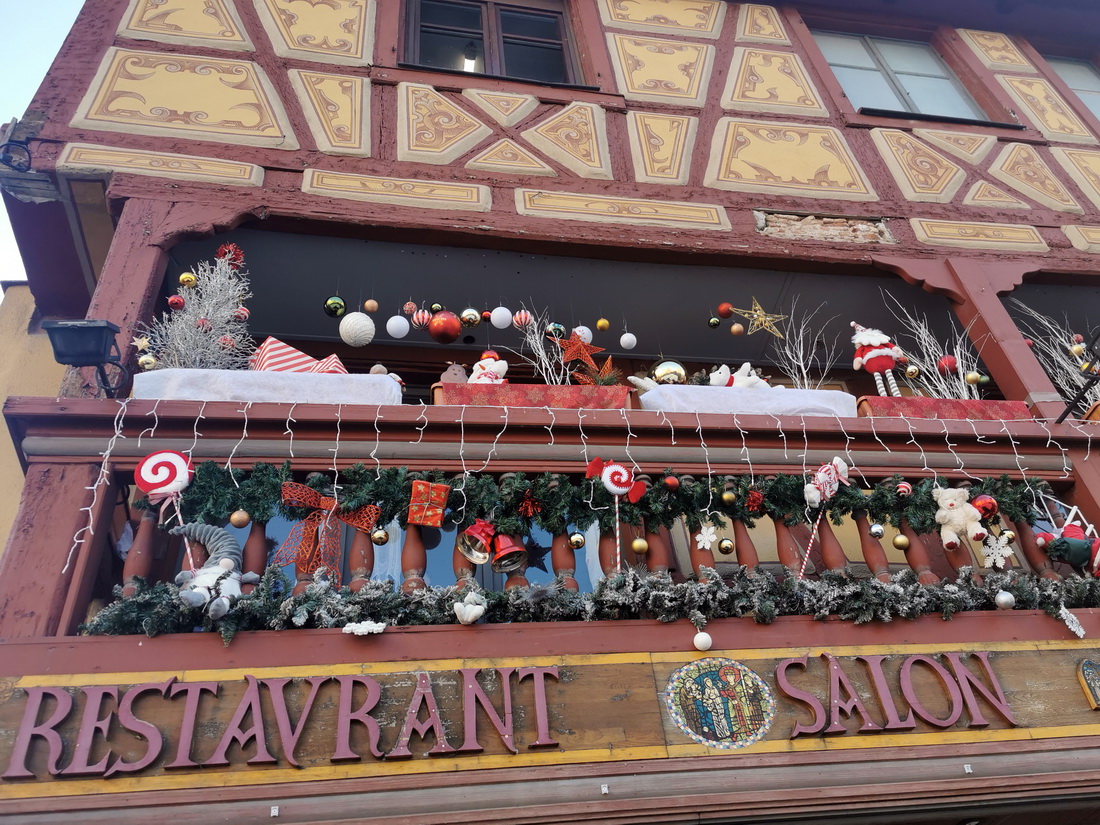
Christmas decorations and teddy bears covering a balcony in Colmar, winter season

Balconies follow the same script.

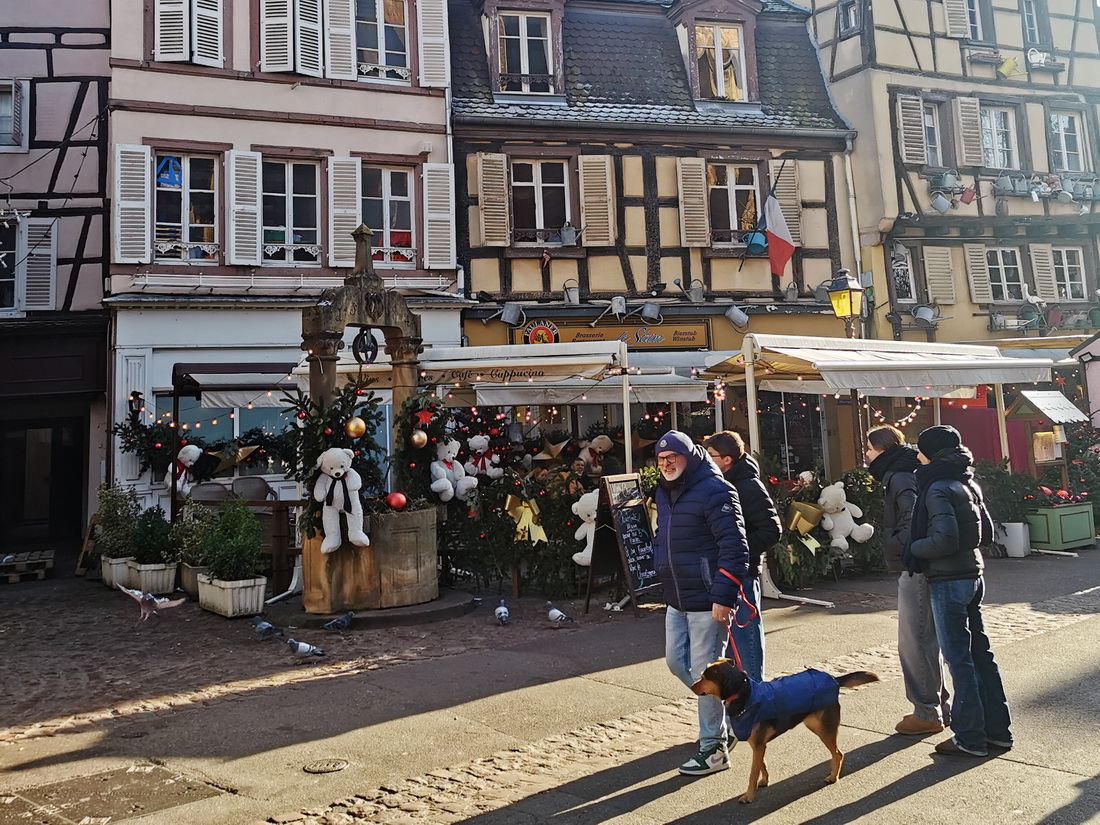
Teddy bears used as winter decorations around a small square in Colmar’s old town

Teddy bears stop being decoration and become part of the street.

It doesn’t escalate. It settles.

You step onto a small square and people stop, phones raised. Instinctively, you assume this must be the peak.

Then you turn a corner — and there’s another square.
Equally dressed. Equally prepared.

And then another.

Nothing competes. Nothing interrupts. Each façade feels finished, resolved, already approved. There are no weak spots to hunt for, no accidental angles. Everything looks as if it has passed inspection.

At some point, I noticed I was taking photos without really looking — lifting the phone, pressing the button, moving on. The images were predictable before I saw them.

Somewhere in the middle of all this, one house broke the rhythm.

An old, carefully restored building. Quiet. Solid. Beautiful.
No lights, no garlands. No bears.

I stopped there longer than anywhere else that day.

Without the decorations, the house didn’t feel empty. It felt present. Its proportions became visible. Its materials spoke. For the first time in hours, nothing tried to perform.

Then I moved on.

The bears were waiting around the corner.

Soon enough, you stop looking for the best spot.
There isn’t one.

They’re all ready.

Decoration at its limit

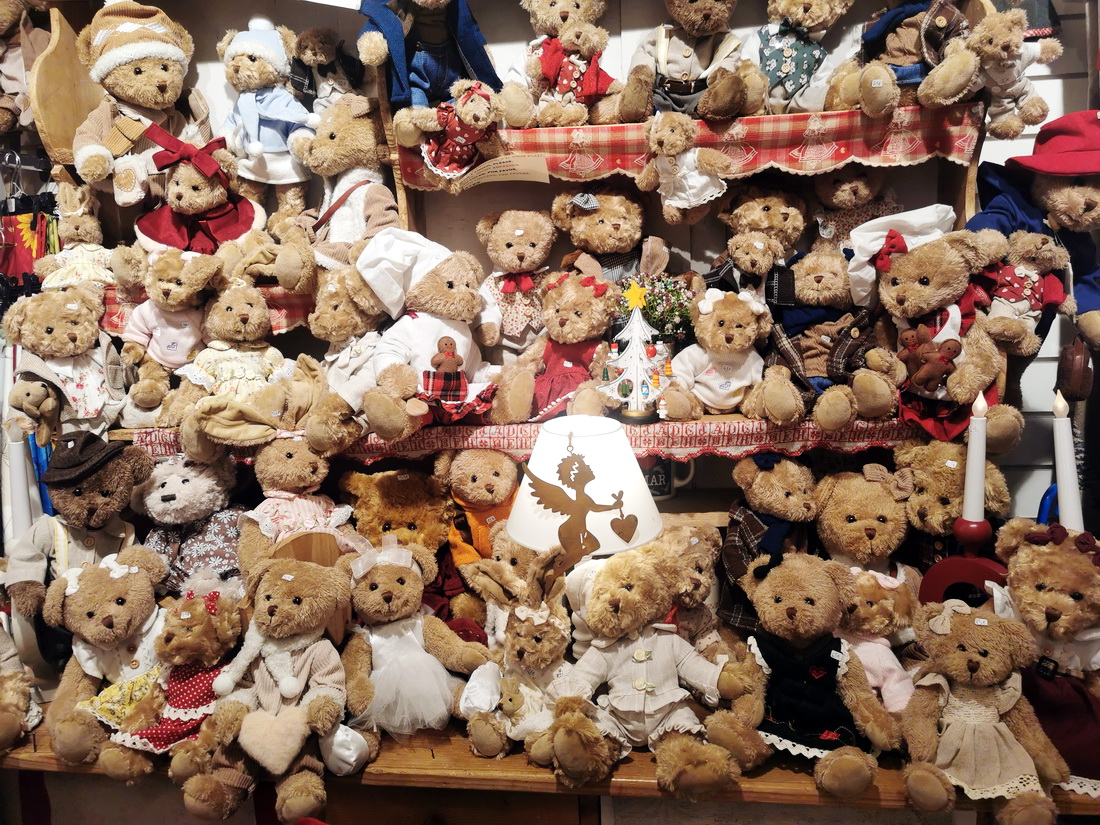
Shelves filled with dozens of teddy bears dressed in different outfits, Colmar winter decorations

This is where quantity starts speaking for itself.

Eventually, Colmar stops behaving like a city and does so without embarrassment.

This happens indoors.

You step inside one of the Christmas shops — it hardly matters which — and the logic tightens. Space compresses. Movement slows. The air feels thicker, not from people, but from objects.

Shelves rise to eye level and beyond. Ornaments cluster by colour, then subdivide by theme. Glass next to wood. Red next to gold. Variations stacked so close together that the difference turns ornamental.

There is no empty space.
No pause.
No mistake.

Your body adjusts before your eyes do. You take shorter steps. You stop turning fully, careful not to brush against anything. Looking becomes deliberate, almost cautious.

This isn’t browsing.
It’s navigation.

The density is impressive, even admirable. Everything is placed with intent. Everything belongs. And yet the longer you stay, the less desire there is to choose.

I went in thinking I might buy a nutcracker. I left without one.

In a town where decoration has already saturated the streets, interiors don’t add another layer — they concentrate what’s outside. The city doesn’t exaggerate itself here. It compresses.

When you step back out, the streets feel wide again.
But not quiet.

The same logic continues, only stretched across façades and squares instead of shelves.

A city designed for the gaze

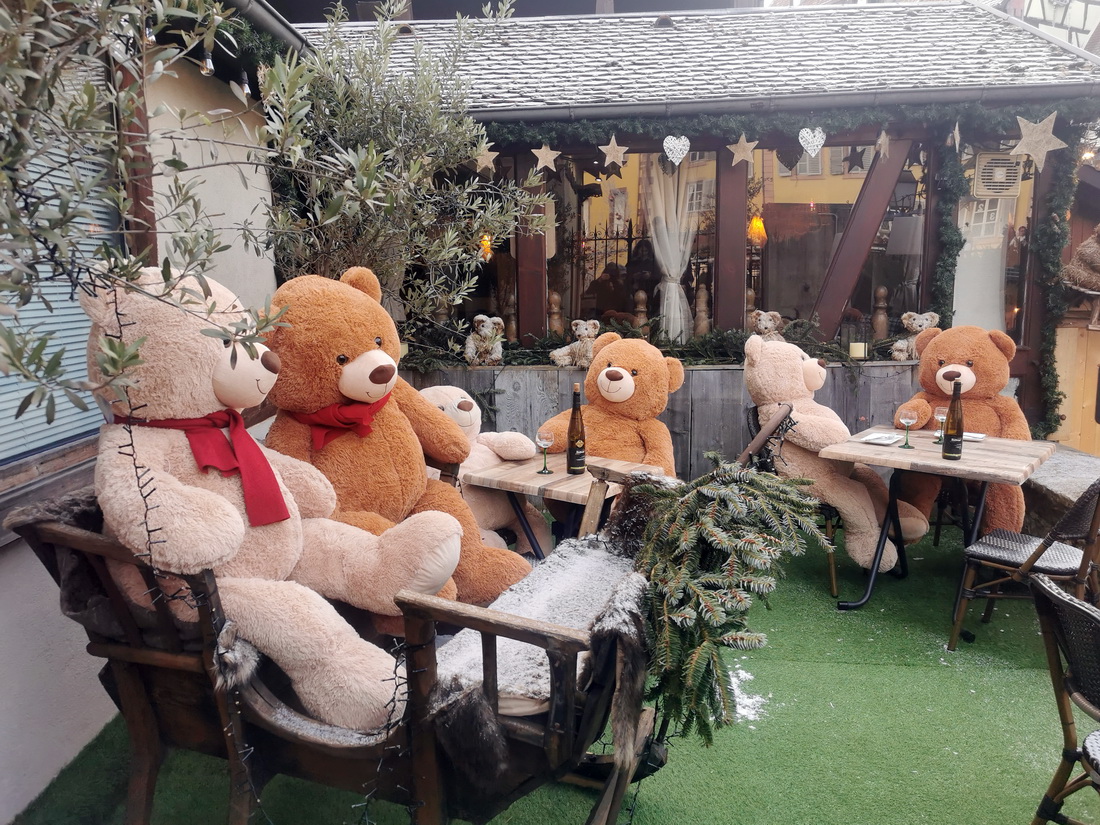
Teddy bears seated at outdoor cafe in Colmar winter

By the end of the day, even the bears seem to take a seat.

Back outside, the streets feel open again.

The density loosens, but the logic remains. Façades still perform. Squares still arrive one after another, complete and resolved. The town doesn’t ask you to move through it — it asks you to look.

The old centre behaves like a continuous stage. Hotels, decorated houses, visitors drifting from one prepared scene to the next. Nothing interrupts the sequence. Nothing pulls attention away.

Everyday life must exist somewhere.
It simply doesn’t surface here.

I caught myself wondering how anyone lives inside this scenery — and immediately thought of Venice. Colmar is smaller, neater, more disciplined. There’s less chaos, fewer cracks. But the effect is familiar. The city organises itself around the viewer.

You stop, you look, you move on.

By now, even that feels rehearsed.

Practical notes (before you decide to go)

These notes reflect my experience of Colmar in winter — not a full travel guide. Read them as orientation, not instructions.

Getting there

The simplest way to reach Colmar is by regional train from Strasbourg. The journey takes around 30 minutes.

Tickets are easy to buy in advance via the SNCF Connect app. For this short route, a standard ticket without a seat reservation is usually enough — especially if you’re boarding at the start of the line. Reserved seats exist, but they’re noticeably more expensive and rarely necessary.

Trains do get busy in winter, but even close to departure there are typically a few free seats left.

From the station, it’s a straightforward 15-minute walk to the old centre. No navigation tricks required.

Timing and pace

I arrived around 10:00 and stayed until 18:00. That window worked well.

It gives you daylight, dusk, and full illumination — without turning the visit into a race. Anything shorter risks reducing the experience to a checklist.

Mornings feel calmer. By late afternoon, the centre fills quickly. Colmar works best when you let the light change instead of chasing “the best spot”.

Weather (December reality check)

In late December, daytime temperatures hovered between −2 and +2 °C. In shaded areas and on grass, there was a thin layer of snow — just a few millimetres.

Cobblestones can be damp or slippery even without snow. More importantly, you’ll spend as much time standing still as walking. Dress for both.

Warming up

You won’t need to plan indoor breaks. Cafés, bakeries, the covered market, and museums appear exactly when you start looking for them.

Consider them part of the rhythm, not interruptions.

Christmas markets

Colmar’s Christmas markets usually open in late November and close around 24–25 December, depending on location. Dates vary slightly between squares, so it’s worth checking the official Noël à Colmar website.

After Christmas, the markets disappear — but the decorations don’t. Crowds thin out, visual noise drops, and what remains is the staging itself.

Museums (one is enough)

If you include a museum, keep it to one.

The Unterlinden Museum, home to the Isenheim Altarpiece, offers a completely different visual register and works well as a counterweight to the town outside.

If you prefer something lighter and closer to Colmar’s decorative logic, the Musée du Jouet fits naturally into a winter visit — less a children’s museum than a catalogue of designed nostalgia.

Food options

Food is easy.

Traditional Alsatian restaurants start around €20–30 for a main meal. Simpler places — pizzerias, bakeries, small cafés — offer filling options for €8–9, coffee included.

There’s no need to plan this tightly. Colmar feeds visitors efficiently.

Accommodation

If you’re staying overnight, Colmar offers plenty of small hotels and guesthouses in and around the old centre. For a broad overview of availability and prices, Booking.com is the easiest place to start.

If you want an alternative platform — especially useful for comparing international listings and occasional price differences — Trip.com is also worth checking.

Mark your spot

The moment you step out of the old town, the shift is immediate.

The lights thin out. The bears disappear. Pavement replaces cobblestones. The performance ends without an encore.

I noticed it first in my body — the relief of space, the ability to walk without stopping, without adjusting my pace to someone else’s photo. My eyes relaxed. My shoulders dropped.

I left with a camera full of images, tired eyes, and a mild overdose of cosiness. Not disappointment — saturation.

Colmar works exactly as intended. It delivers amazement with precision and excess, then lets you go.

It’s perfect for one winter day.
For looking.
For being impressed.

Whether it’s a place you want to stay longer is a different question.

And that’s where you mark your spot —
either here, inside the frame,
or somewhere just beyond it.

What to read next: