















I really wanted to get to the Château du Haut-Kœnigsbourg. Our host in Strasbourg — Élodie, kind and endlessly knowledgeable — had told us it was unmissable. It is a massive reconstruction of a medieval fortress, a romantic vision of the Middle Ages built in the early 20th century.
For me, raised on historical novels, a castle is always a story in itself. I checked the website: January 3rd and 4th were the last days it was open before a break.
So we took a local train. Sélestat sits on the flat Alsatian plain between Strasbourg and Colmar, with the Vosges mountains rising dramatically behind it. The ride takes only about 20 minutes (though some slower trains take 45). Tickets vary, but we paid around €11 one way.
The train network is the spine of Alsace, allowing for spontaneous detours like this one. To keep your itinerary flexible, I recommend positioning yourself strategically near the rail hub. See my analysis of the most efficient base in Where to Stay in Strasbourg.
Waiting for a bus that never came
The station in Sélestat is small. You step out onto a quiet square. There was just one bus, with no signs or route numbers. We walked straight towards it — surely this was the shuttle (Navette 500) taking us to the castle?
It wasn’t.
The driver shook his head. “Your bus is about twenty metres from here,” he said. So we moved, and waited.
Finally, a minibus arrived. It had about sixteen seats. We rushed towards it, relieved and hopeful — only for the driver to announce that the castle shuttles were cancelled for the day.
A group of Italian tourists started swearing and marched back to the station. They had lost both time and money. We tried to find a taxi, but on a sleepy Sunday morning, it felt as if the whole town — drivers included — was still in bed.
Disappointed and tired of waiting, I decided to walk into town instead.
A quieter edge of the old town
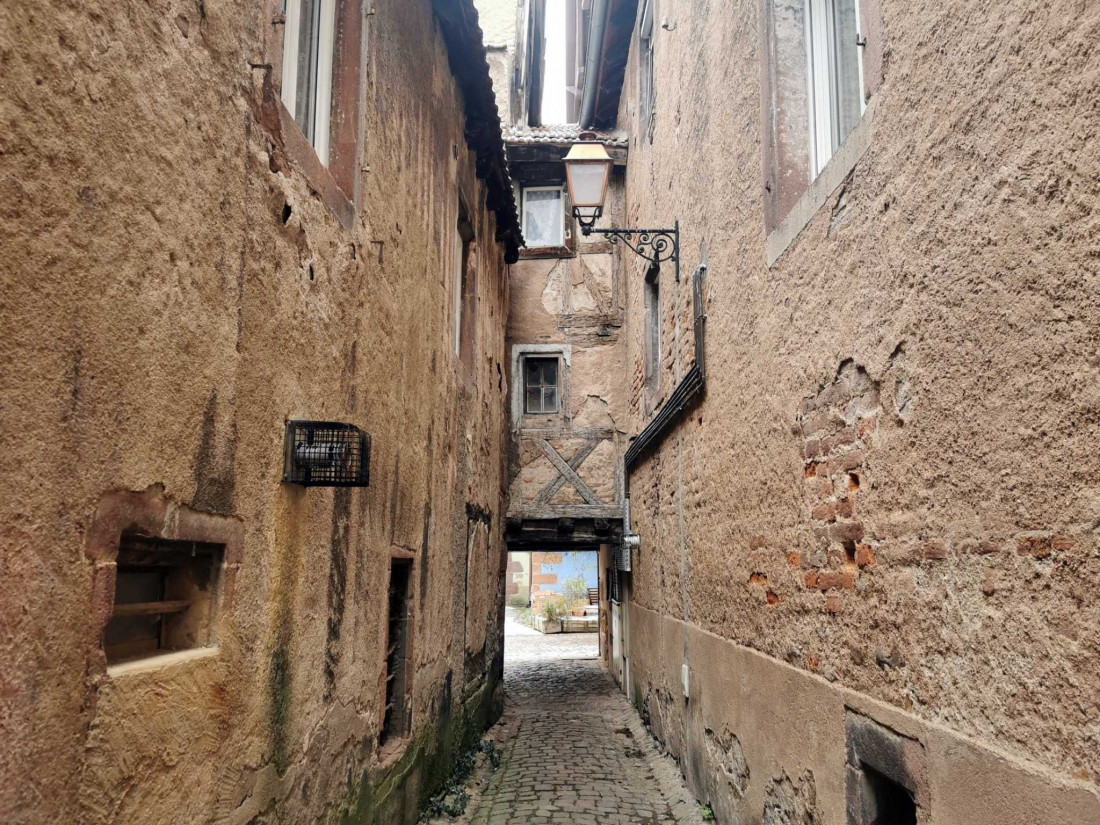
After leaving the station area, I didn’t take the main route into the historic centre. Instead, I entered the old town from its quieter edge.
Here, the houses leaned close to each other, some still showing their medieval bones beneath later layers. Timber frames were darkened by wood smoke and age rather than fresh paint.
Unlike the perfectly polished, candy-coloured facades of Colmar that look ready for Instagram, Sélestat feels grounded. The pastel pinks and greens are faded here, revealing the texture of centuries.
Stone and silence
Walking deeper, the skyline suddenly shifted. Two massive churches rose above the roofs, standing almost shoulder to shoulder in the grey winter light — one Romanesque, squat and red, the other Gothic and soaring.
I also passed a striking building where modern glass merged with ancient stone — the famous Humanist Library. I didn’t go inside, but just its presence reminded me that this quiet provincial town was once a capital of European intellect.
It was only later that I discovered Sélestat holds another title: the birthplace of the Christmas tree, first mentioned here in 1521. Walking through the silent streets, it was strange to think that such a global tradition started in this modest, unhurried place.
The streets were almost empty. It felt as if everyone was still in their kitchen, drinking coffee. The silence had something cinematic about it: you could imagine small scenes of everyday life unfolding behind the walls, or simply stand there and look.
A Fair Trade
Eventually, the winding streets led me to the main square, where the town feels more official, more ready for visitors. But I was glad the route had turned out the way it did — first through the unpolished, waking-up side of Sélestat, and only then into its familiar heart.
I had come here for the castle — a grand, romantic reconstruction of the Middle Ages. I didn’t see it. Instead, I got Sélestat: quiet, faded, and undeniably real.
It wasn’t the Sunday I planned, but looking back, it feels like a fair trade. The castle would have given me a spectacle; the town gave me a moment of genuine life.
Travel Notes
Sélestat
check out the Sélestat: Walking tour of the city of the giant Sletto.

