













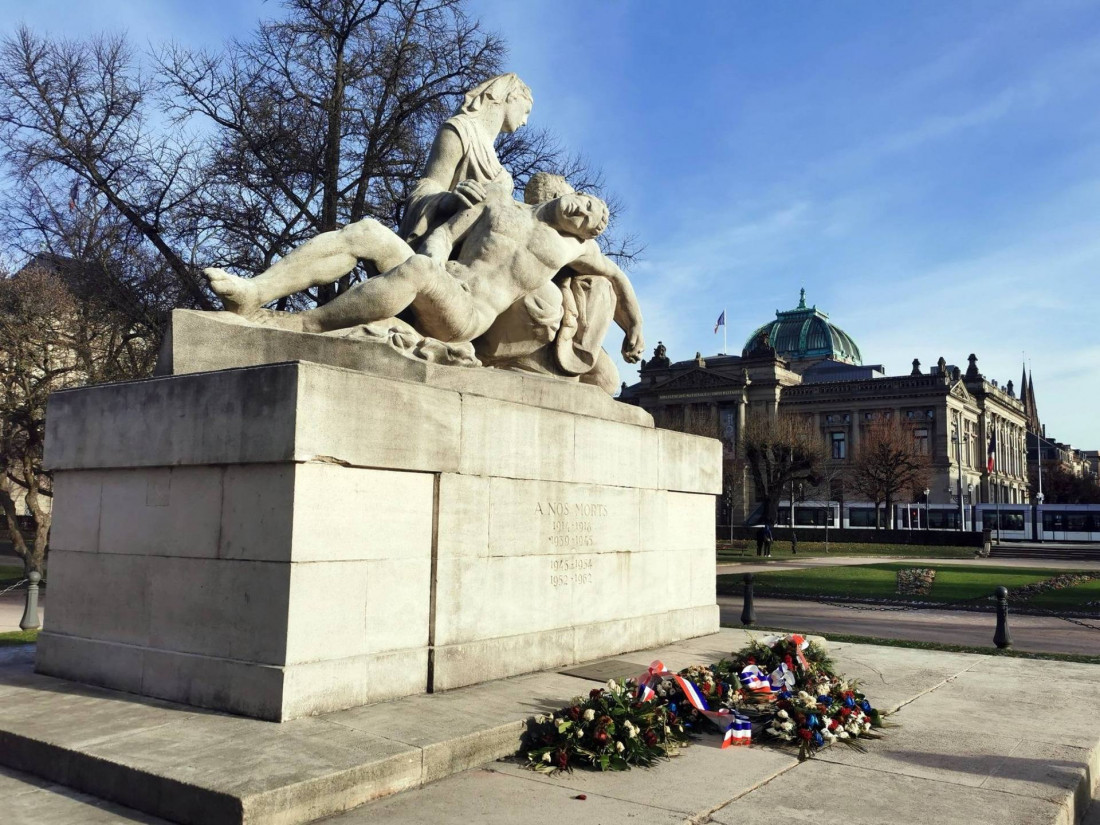
At the centre, slightly set back from the tram lines, a mother holds two dead sons. One died for France. The other for Germany. No raised arms, no flags, no heroic angle — just weight, carried.
This is the Monument aux morts de Strasbourg, unveiled in 1936 — nearly two decades after Alsace had returned to France, with the reckoning of the First World War still unfinished. The choice it makes is stark: no victory, no side. Only loss — doubled.
Loss Without a Heroic Narrative
That restraint is the point. Designed by Léon-Ernest Drivier, the monument reflects a conscious decision: to remove everything that might soften the meaning.
What remains cannot be argued with — a war that took two sons from the same mother, each drawn into service under a different flag, and claimed more than eight million lives between 1914 and 1918, many of them conscripted and sent to fight far from their homes.
Unlike many Strasbourg war memorials and war memorials elsewhere in Europe, this monument avoids any hint of triumph or national narrative. There are no inscriptions celebrating victory, no allegorical figures offering consolation, no suggestion that sacrifice was justified by outcome. Instead, the sculpture insists on ambiguity — and on the shared human cost of a war that forced people to fight under flags they did not choose.
In Alsace, where borders and allegiances shifted repeatedly in the first half of the 20th century, this refusal to simplify carries particular weight. The monument does not explain history. It holds it, unresolved.
A Familiar Perspective
From Estonia, the message is easy to read. Not as a grand European lesson, but as a familiar warning about life lived between larger neighbours — and about decisions made elsewhere that arrive here as names carved in stone.
I took a photograph. Not to collect an image, and not to frame a memory neatly. Some places don’t allow a quick exit.
Travel Notes

