










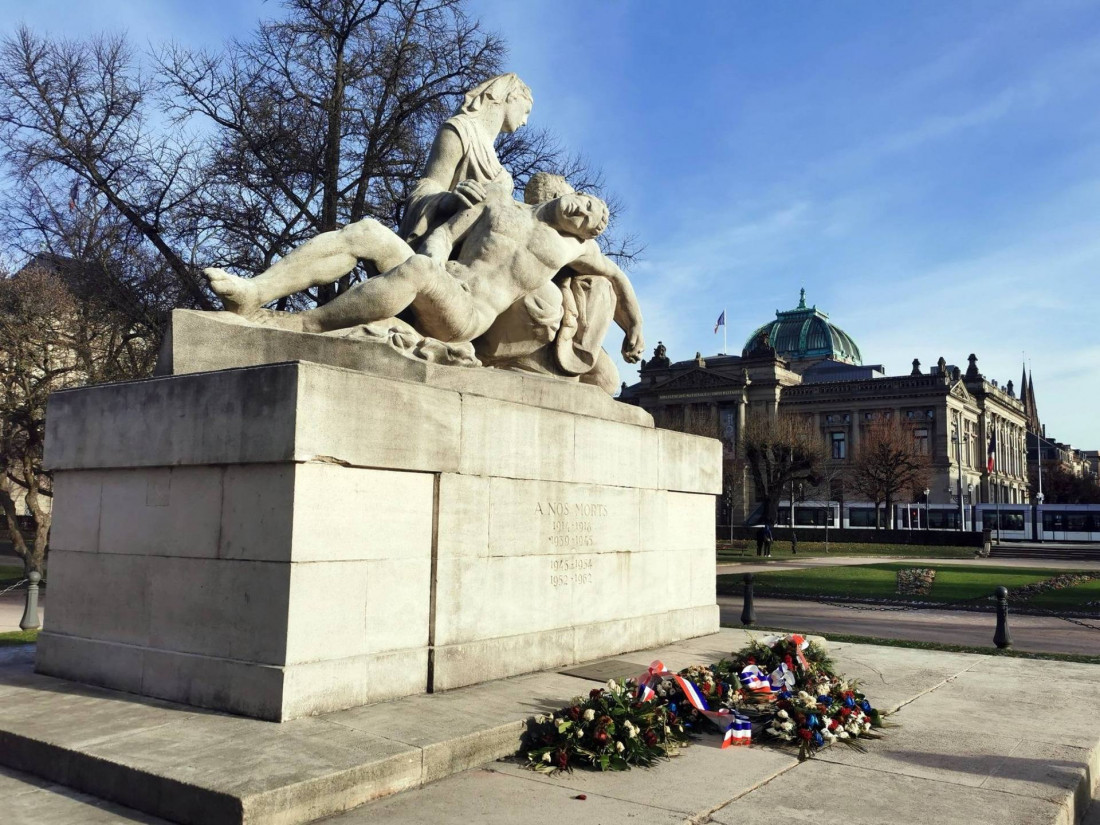
The Monument aux morts de Strasbourg is not a place for national chest-thumping.
Unveiled in 1936, this Strasbourg war memorial marks the loss of Alsatian soldiers in World War I, but it doesn’t bother with the usual heroic narratives.
Set back from the tram lines, a mother holds two dead sons. One died for France; the other for Germany. No raised arms, no flags, no triumph—just the heavy, collective weight of a region caught between two neighbours.
The Architecture of Ambiguity
This WW1 memorial in Strasbourg, designed by the sculptor Léon-Ernest Drivier, is an anomaly among French military monuments. It lacks the typical inscriptions celebrating victory or glory.
Instead, this Place de la République monument forces a quiet, uncomfortable ambiguity. It is a site of remembrance for the casualties of the First World War, holding the unresolved history of Alsace—a land that repeatedly forced families to fight under flags they didn’t choose.
Finding Silence in the Imperial Grid
If you find yourself in Strasbourg, this site is a necessary counter-weight to the city’s more festive attractions.
- Location: The memorial sits in the heart of Place de la République. You can walk there from the Old Town or catch tram lines B, C, E, or F to the “République” stop.
- Duration: It takes about 15 minutes to look at the sculpture and take in the scale of the Neustadt district.
- What to see nearby: You are in the heart of the Neustadt district, the former German Imperial Quarter. Three minutes away is the Musée Tomi Ungerer. It is the perfect antidote to the memorial’s weight—Ungerer’s sharp, often cynical perspective on the human condition feels right at home here. For more on the district’s orderly grid, see my notes on staying in the Neustadt.
- Context: To understand how Alsace swung between 1871 and 1945, a Guided Walking Tour through the Wars is the most efficient way to parse the history.
The Borderland View
From my perspective in Estonia, the message is easy to read. It isn’t some distant European lesson. When your geography places you squarely between competing empires, national loyalty is a luxury; survival often dictates the uniform you wear.
In the Baltics, we know exactly what it means to be caught in the geopolitical machinery of larger neighbours. During the Second World War, successive occupations meant Estonian men were forcibly mobilised into both the Soviet Red Army and the German military. Families were routinely split, with brothers finding themselves shooting at each other from opposite sides of the front line—not out of ideological conviction, but depending entirely on which foreign power happened to control their village at the time of the draft.
Looking at the bronze mother holding two sons who died for opposing nations, the parallel is absolute. It is the shared, grim reality of borderlands: being forced to bleed for flags you never asked to fly.
I took a photograph, but not to collect a trophy. Some places don’t allow a quick exit. This memorial is one of them.
Essential Details
Who designed the Monument aux Morts de Strasbourg?
The monument is the work of French sculptor Léon-Ernest Drivier. Unveiled in 1936, it was designed specifically to address the long-lingering, unfinished reckoning of the Great War in Alsace.
What is the symbolism behind the sculpture?
It represents the grim human cost of war rather than a national narrative. By depicting a mother grieving two sons who died for opposing nations, it focuses on the tragedy of divided families and shifting national borders.
Why is this memorial considered a ‘must-see’?
If you’re looking to step away from the postcard-perfect parts of Strasbourg, yes. It provides a rare moment of silence and a deeper look at the city’s complex, often painful history.

