














I walked the standard loop, but my interest wasn’t in the monuments. I was trying to understand the logic of a city that feels simultaneously perfectly open and tightly locked.
The Mushroom Index
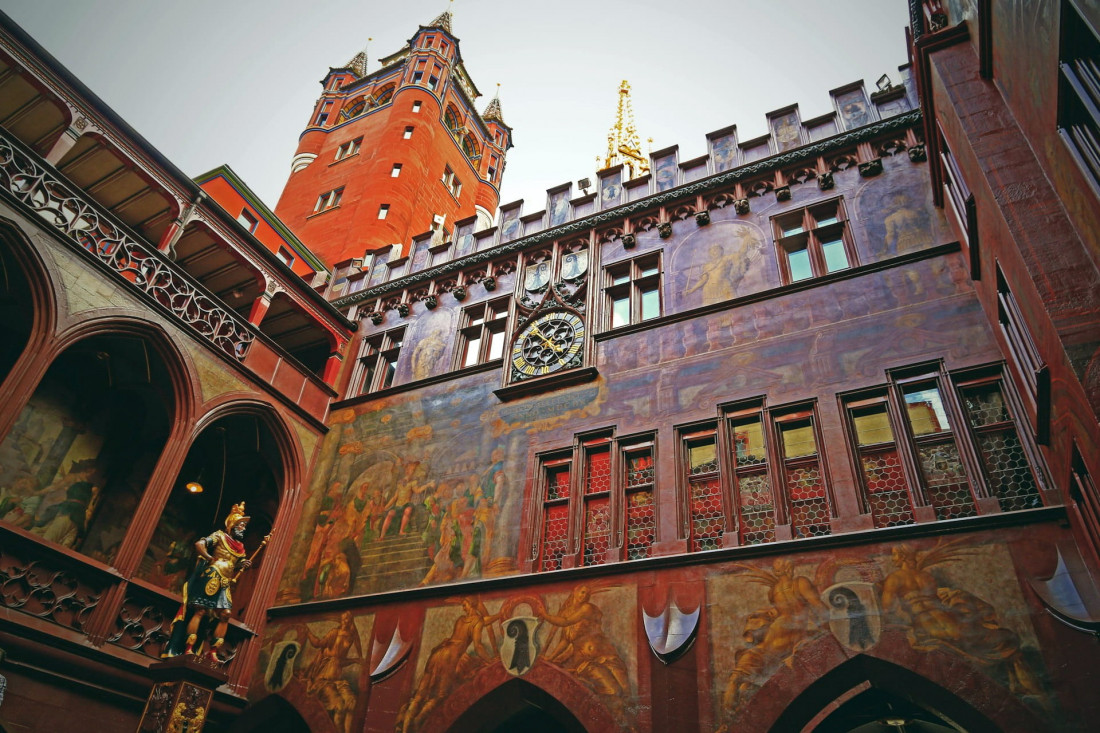
The route starts at the Marktplatz. The Town Hall (Rathaus) dominates with aggressive red and gold. Beneath it, the market operates with surgical cleanliness.
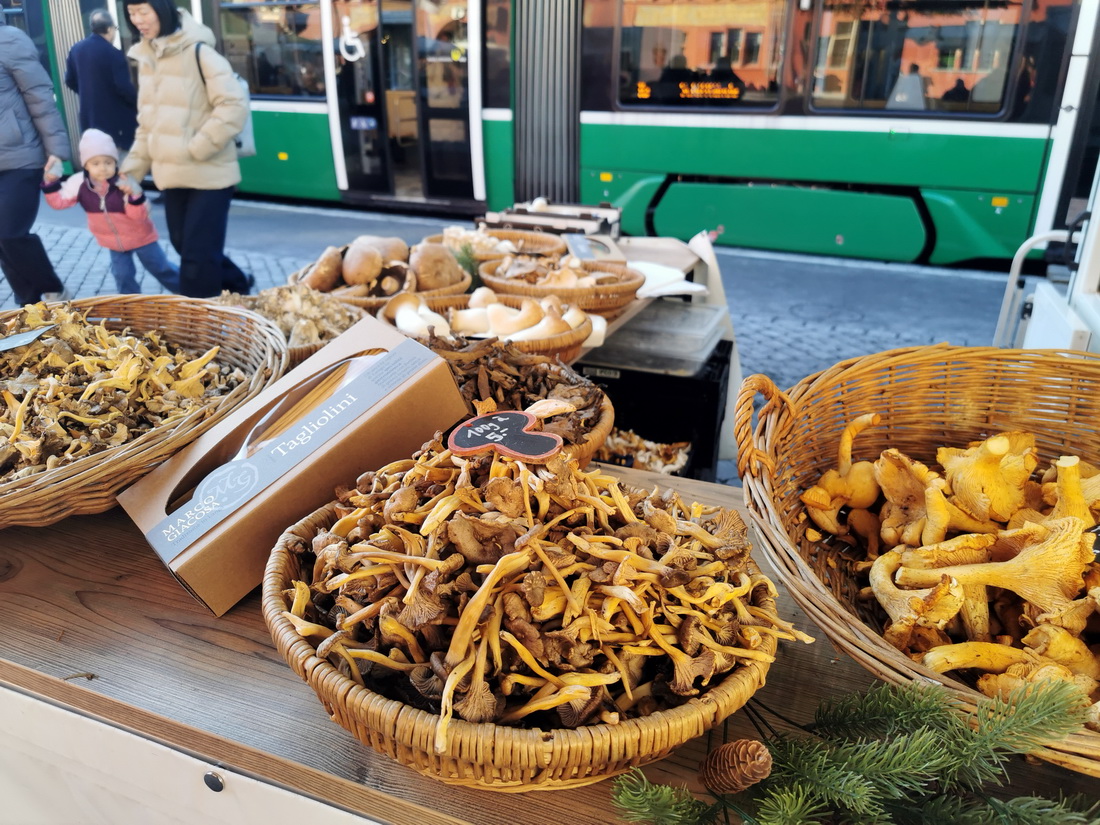
The “Mushroom Index” in action. At 50 CHF per kilo, humble tube chanterelles cease to be food and become a luxury asset.
I stopped dead in front of a crate of tube chanterelles. These are humble mushrooms; the kind I gather by the basketful back home. In the forest, they are free and dirty. But on this counter, they lay perfectly clean, arranged like jewelry, with a price tag to match. It was a jarring shift in context. The object is the same, but the status has changed. Here, nature is a luxury asset.
This price tag is a good lens for the whole city. Looking at this polished surface, one might imagine a progressive utopia. In reality, the wealth is undeniable, but so is the stratification. The city doesn’t scream about this gap; it simply manages it with a polite, expensive silence.
The Democratic Bank
To escape this rigidity, you must cross the river. I walked over to Kleinbasel, the opposite bank facing the sun. This is the city’s necessary release valve.
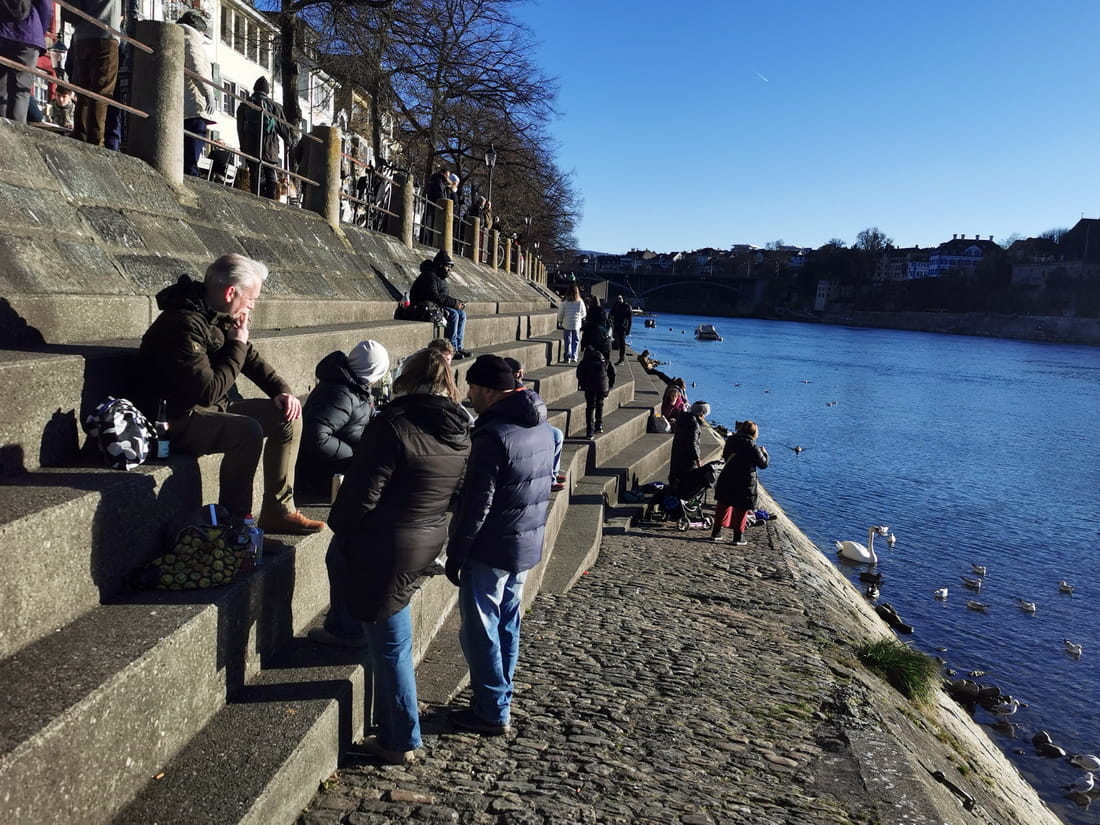
Here, the strict Swiss decorum dissolves. On these concrete steps, the barrier between the city and the river disappears completely.
The contrast is physical. If the Old Town is vertical and stone-faced, the promenade here is horizontal and human. People sit on the concrete steps that descend directly into the Rhine.
In summer, I am told, this river turns into a chaotic highway of swimmers clutching colorful dry bags (the famous Wickelfisch). But in January, the Rhine is strictly for the swans. The water looks fast, cold, and serious—just like the banking district across from it. Yet even now, the steps remain the city’s living room, where the view of the expensive Old Town is free for everyone.
The Introverted Garden
Crossing back and climbing toward the Cathedral (Münster), the architecture turns defensive. The walls go higher; the streets narrow. I watched the windows of the private houses, trying to catch a glimpse of life inside.
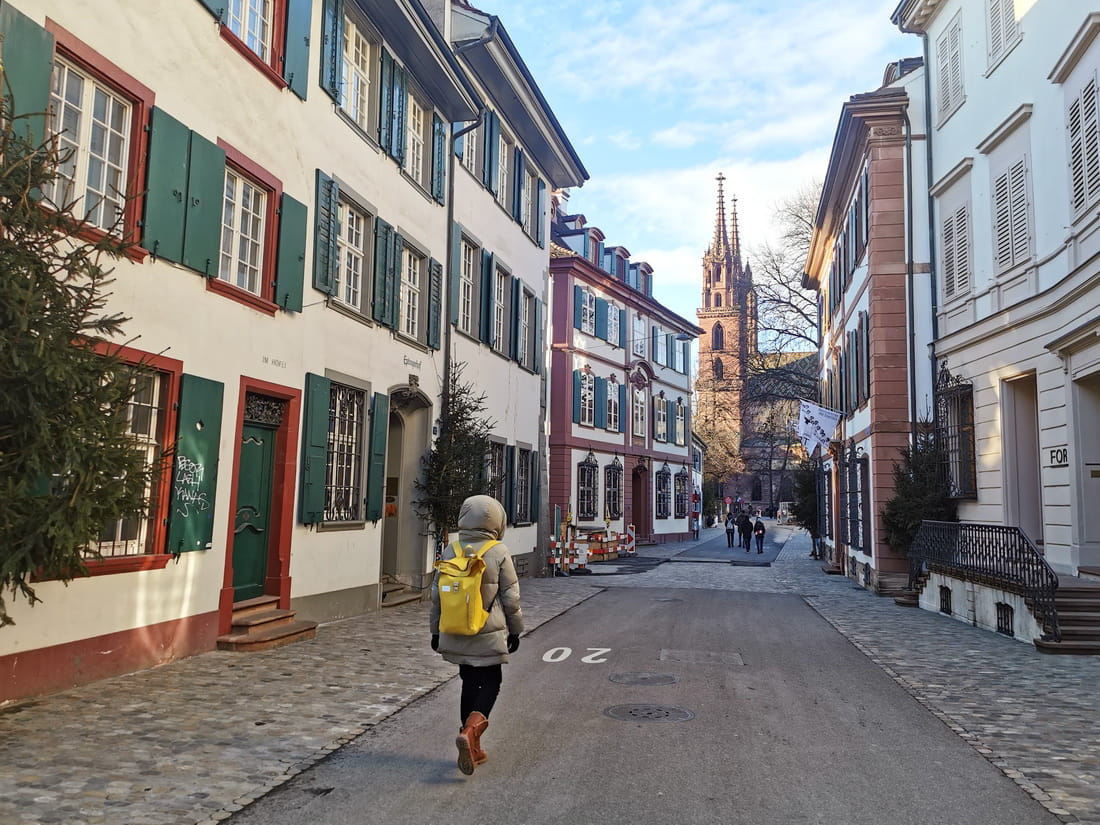
“The streets narrow.” Climbing toward the Cathedral, the city noise vanishes, replaced by the echo of your own footsteps.
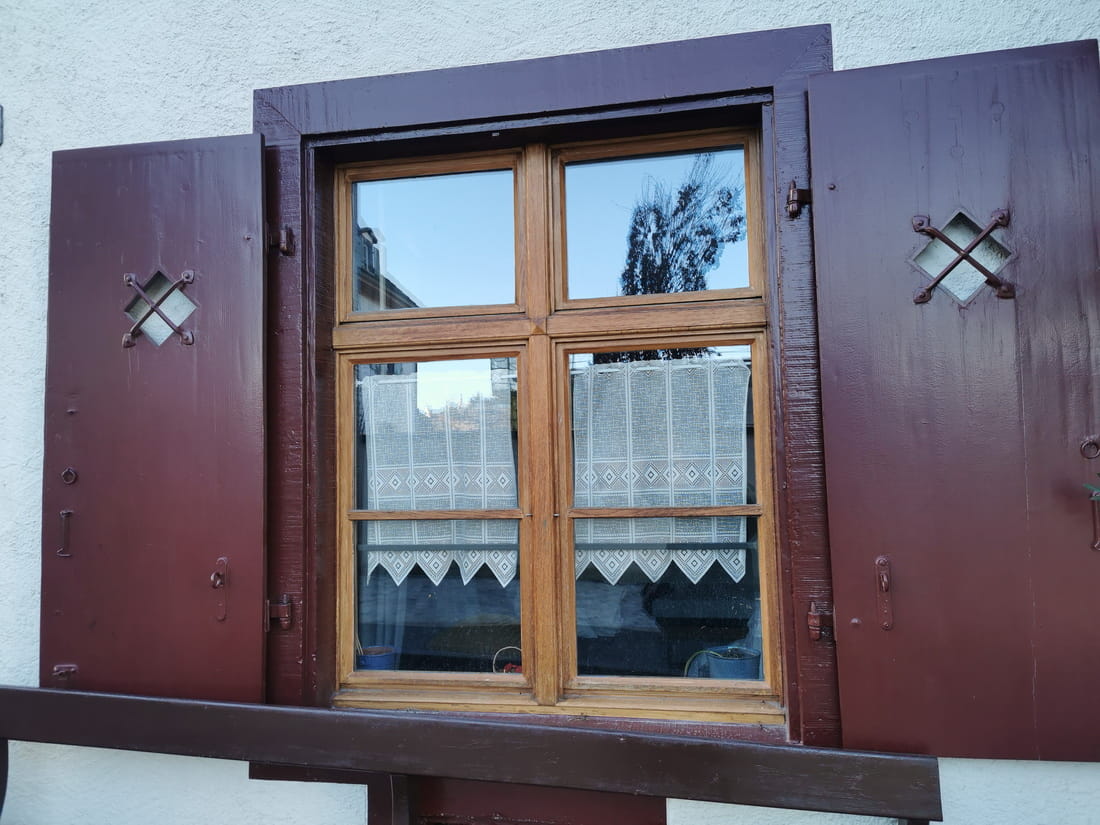
“These windows are not eyes; they are shields.” Even the curtains in Basel act as architectural barriers: look, but do not enter.
But these windows are not eyes; they are shields. Heavy grates, layers of curtains, and the deliberate display of a single candle. The message is clear: “Look, but do not enter.” Wealth here is private, not public.
The Cathedral dominates the hill, but the true essence of Basel isn’t the spire pointing at God; it’s the stone cloisters tucked behind it. Walking through them, the city noise vanishes instantly, replaced by the echo of your own footsteps. It is a pocket of vacuum-sealed silence. This is the architectural blueprint of the Swiss soul: the most beautiful parts are introverted, enclosed, and hidden in the backyard.
The Machine and the Irony
What holds these contrasting worlds together is the rhythm. The city is stitched tight by green tram tracks. I never boarded one, but they dictated my walk—gliding past like silent, electric snakes. They are efficient, punctual, and humorless. They are the pulse of the machine.
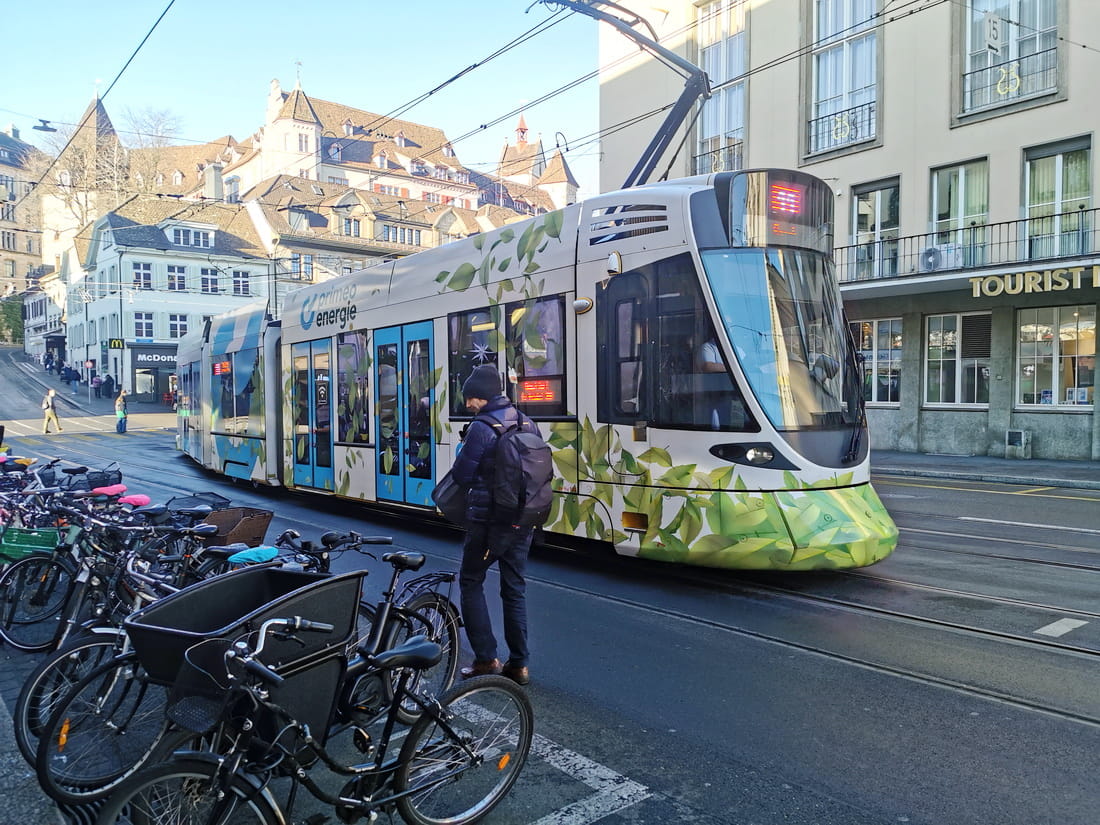
The Machine: Silent, efficient trams dictate the rhythm of the city.
But every machine needs a glitch. Near the theatre stands the Tinguely Fountain, Basel’s moment of self-parody. Here, contraptions made of scrap metal and black rubber scoop water, splash, clank, and struggle uselessly against the ice.
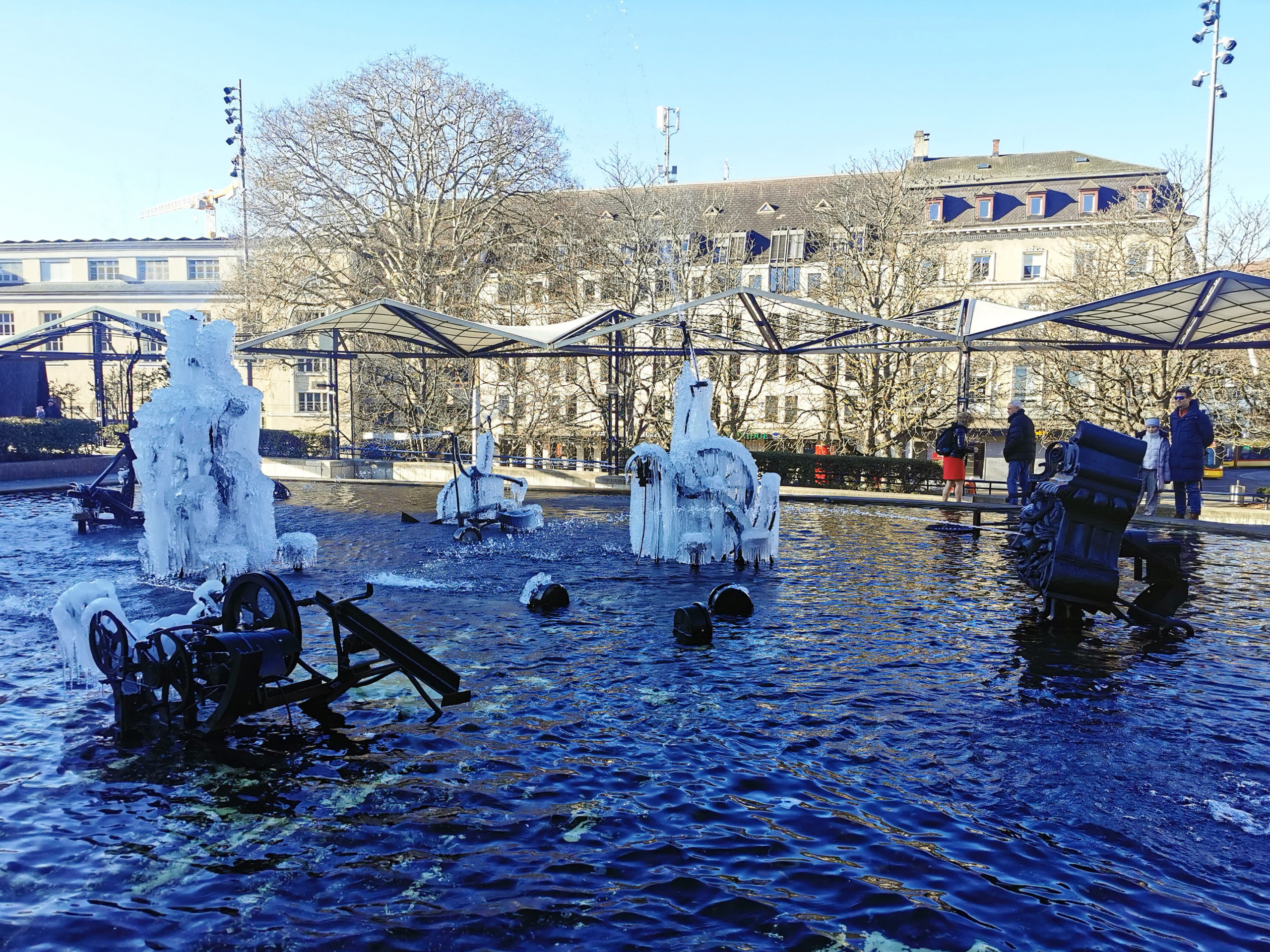
The Irony: Tinguely’s mechanical sculptures struggle against the winter ice, providing the city’s necessary dose of madness.
It is a brilliant counterpoint. If the trams represent the Swiss obsession with silent efficiency, Tinguely’s sculptures represent the necessary madness. One mechanism runs the economy; the other, useless and noisy, keeps the city’s soul alive.
Travel Notes

