










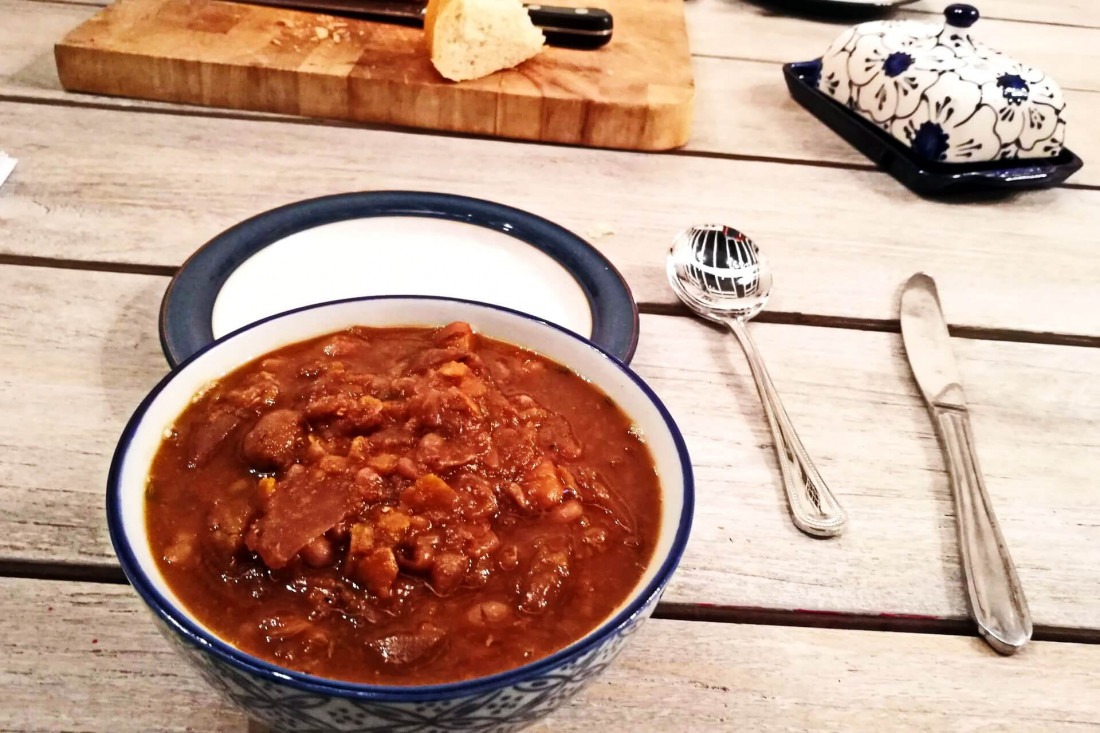
The stone farmhouse on Guernsey – an island anchored in the Channel between England and France – was exactly as draughty as a centuries-old building should be. My host, navigating the kitchen with a hyperactive spaniel underfoot, handed me a bowl of something dark, dense, and intensely savoury.
It was a Guernsey Bean Jar. My host had made a modern vegetarian version, and it remains one of the best things I ate on the island. The beans had cooked down into a rich mass, proving that time and residual heat usually do the heavy lifting.
Why Guernsey Outsourced Its Sunday Dinners
Today, we spend small fortunes on heavy cast-iron pots and treat slow-cooking as an artisanal weekend hobby. But the Guernsey Bean Jar was less a philosophy of slow food than a way of making a little household fuel go further.
Keeping an oven hot for hours was an expensive proposition for a working household. Firewood and coal were valuable resources, not something a family could afford to burn for half a day just to cook beans. So, islanders used the existing infrastructure – a tactic shared by working-class families across Europe, driving the creation of dishes like French cassoulet and the Jewish cholent.
Once the local bakers finished their shifts around 18:00, their large brick ovens still held hours of residual heat. Families would drop off their earthenware pots, filled with cheap cuts of meat, root vegetables, and dried beans. To avoid Sunday morning mix-ups, they marked their pots with coloured string, paper tags, or specific notches on the lids. The pots braised overnight as the ovens slowly cooled. The next morning, families picked up a heavy, hot meal. It was purely pragmatic.
How the Stew Survived the 1940s Occupation
During the WWII German occupation, the Bean Jar didn’t disappear – it adapted. As household coal and wood supplies dwindled to nothing, the communal bakery ovens became a lifeline.
Rationing dictated what went into the pots, and meat became severely scarce, but the fuel-saving method became a matter of survival rather than just thrift. Utilising the residual heat of the bakeries was actively encouraged by the authorities. The stew survived the war because its economic logic was flawless at a time of absolute scarcity.
A Vegetarian Take on the Guernsey Bean Jar
There is a distinct irony in making a Bean Jar today. A dish invented to save on household fuel now requires you to run an electric oven for up to eight hours. If you have a modern slow cooker, this is exactly what it was built for.
Traditionally, a Bean Jar was built around cheap cuts of salted beef, pork belly, and a pig’s trotter. The trotter wasn’t just for flavour – its collagen broke down into gelatin, giving the cooking liquid a thick, sticky richness. This is my host’s vegetarian adaptation. While you lose that signature dense texture without the pork, it completely respects the dish’s true foundation: beans, time, and economical heat.
Recipe
The Beans: You need 500g of dried beans (a mix of butter beans and haricot beans). Do not use tinned beans – they will disintegrate during a long bake.
The Soak: Soak the beans in cold water overnight. Drain them thoroughly in the morning.
The Base: Lightly fry 3 diced carrots and 3 diced onions in a pan until soft.
The Assembly: Transfer the vegetables and soaked beans to a heavy casserole dish. Pour in vegetable broth (roughly 1 to 1.5 litres, depending on your pot) until the liquid sits about 5 cm above the beans. Add 3 bay leaves and a handful of mixed herbs.
The Bake: Preheat the oven to 120°C (you want a slow, gentle braise, not a boil). Bake for 6 to 8 hours. Check occasionally and top up with boiling water if it looks dry.
The Finish: Remove bay leaves, season generously with salt and pepper, and serve hot with crusty bread.
You won’t find Bean Jar on every menu, but it still turns up in cafés, kiosks, and restaurants around the island (places like Richmond Kiosk at Vazon Bay regularly serve it). If you spot it, order it. It is thick, deeply savoury, and exactly the kind of heavy, unpretentious food you want after a long walk on a cold day.
More from the Channel Islands:
If you are exploring the archipelago, I also wrote about Sark. It is an island with no cars, zero streetlights, and a public transport system run entirely by tractors.

