











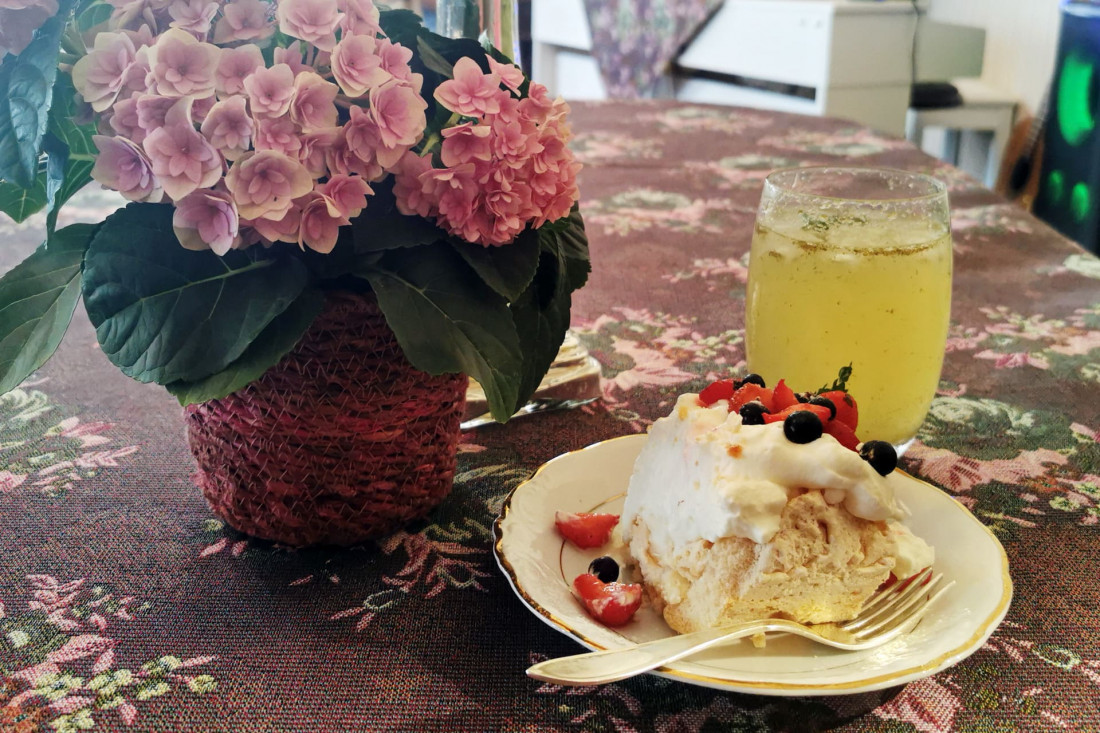
Visually, the Pavlova is built for delicate garden parties. It is a fragile architecture of spun sugar and air that looks like it should sit on a terrace in Sydney, not next to a rugged Estonian farm.
Yet, the contrasts here are part of the daily routine. The thermometer outside might read -20°C. You might have just trudged through deep snow, the kind that squeaks like styrofoam under your boots, expecting culinary logic to dictate hearty stews, dense rye bread, and blood sausage.
But sitting in the display case of a rural farm café just outside Tallinn, sharing the same glass cabinet with pickled herring and meat pies, is a defiance of geography: a perfect, fragile Pavlova.
It creates a bizarre culinary bridge across the globe. My friends in Australia are currently messaging me about beach weather and mango season, yet this exact Southern Hemisphere icon suddenly connects us.
Estonia – a famously pragmatic nation – has quietly taken this tropical summer dessert and made it a permanent fixture of its café culture. For anyone researching what to eat in Estonia, it has become one of the most surprising, yet ubiquitous, local staples.
The History of Pavlova in Estonia
The standard history is well known: chefs in 1920s Australia (or New Zealand, depending on who you ask) created the dessert to honour the Russian ballerina Anna Pavlova.
In Estonia, that name doesn’t feel like an exotic import. Roughly a third of the population has Russian roots, so a Russian surname on a menu barely registers.
The real reason it stayed is purely practical: the recipe requires only the most basic, accessible ingredients. With just eggs and sugar, it takes a foreign dessert and turns it into a simple, everyday base for whatever local berries you manage to harvest.
A Year-Round Canvas for Foraged Berries
The core of its success lies in the forests. The short, frantic Nordic summer triggers a deep local instinct: foraging. Estonians spend it gathering buckets of raspberries, bilberries, and lingonberries.
Cafés in Tallinn and far beyond the city limits use the Pavlova as a blank canvas of sugar and air, designed to showcase this loot – whether it is piled high with fresh berries in July or pulled from the freezer to put a piece of summer on a plate in the middle of February.
This mastery of seasonal ingredients is the backbone of local dining; for a deeper dive into how this plays out across the rest of the menu, see my guide to Estonian Food: Traditional Dishes, Everyday Staples, and What to Try First.
The €11 Plate vs. The €2 Paper Box
This obsession has created a wild economic spectrum. You can find a single-serving Pavlova for €2 in a roadside summer pop-up or pay €11 for a styled version in the capital.
To be fair, around 70% of local pastry chefs handle the delicate meringue with genuine skill, regardless of the venue.
But take note: price is rarely a reliable indicator. I have encountered dry, chalky disappointments in high-end spots and absolute perfection in unassuming takeaway cartons.
Take the annual street festival on Pikk Street in Toila, for example. One local resident is famous for selling homemade Pavlovas straight from her yard.
Packed in simple cardboard and heavy with the fresh forest harvest, they draw people from neighbouring towns who drive in just to queue. They sell out almost instantly. It proves that this isn’t just a restaurant trend – it is a genuine, grassroots obsession.
The Farmhouse Paradox
This grassroots obsession reaches its absolute peak far beyond the city limits. I found my most memorable version on a working farm in the countryside – a place that breeds sheep and cultivates roses.
The setting dictated something else entirely. Heavy, fire-roasted šašlõkk (meat skewers) anchored the menu – exactly the kind of utilitarian fuel you expect in this environment. Yet, right next to the meat, they offered a cloud of sugar. I ordered it out of pure, stubborn curiosity.
It quietly undermines the idea that rural Estonian food is purely utilitarian. The smell of roasting meat and wool might surround you, but the kitchen still operates with the precision of a Viennese patisserie.
I sat on the wooden terrace, breathing in the scent of woodsmoke and blooming roses, and took a bite. It shattered instantly. Even in the middle of a brief Nordic summer, the scorching beaches of Sydney felt like a distant, impossible world.
Gastronomy Notes
Quality Control: How to Spot a Proper Pavlova
This delicate cloud of sugar and air is, admittedly, an anomaly in this part of the world. If you want a dessert that actually tastes like regional history – heavy, dense, and built for peasant survival – you are better off looking across the Baltic Sea at authentic Åland pancakes.
But the Pavlova captures a different, very specific Estonian trait: hiding highly refined things behind a rugged, unpretentious exterior.
You don’t need to drive to a remote sheep farm to see this dynamic. It is the defining feature of the capital, where rough medieval stone walls and Soviet-era industrial zones now house world-class bakeries and minimalist kitchens. If you want to navigate this contrast properly and skip the standard tourist traps, read my Complete Guide to Tallinn.

