











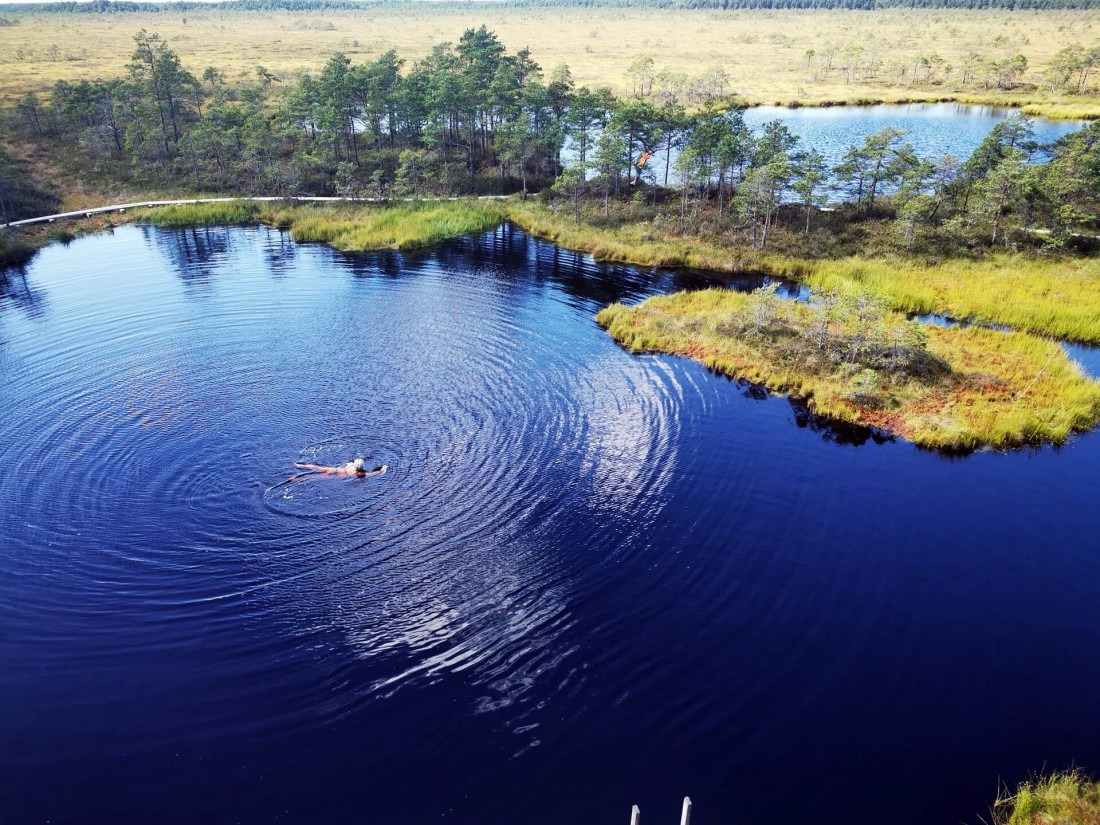
Bogs and wetlands cover roughly a fifth of Estonia, but not all of them look like the postcard version. Stand in the middle of a raised bog, with nothing but moss, pools, and sky around you, and it is easy to imagine how difficult this landscape once was to cross. Today, people come here mainly to walk and swim. Here is how you actually navigate them.
In Brief
- What it looks like: An open landscape of sphagnum moss and dark water. It is a specific ecosystem, not just a damp forest.
- Why go: Swimming in peat-filtered water; minimalist photography; the heavy scent of marsh tea (Rhododendron tomentosum) in the summer heat.
- What can go wrong: A wet leaf on the boardwalk acts like ice. In rainy years, sections of the trail flood completely.
- What takes longer than you think: Boardwalk length is deceptive. A 4 km route can easily take three hours when you factor in passing other walkers, climbing watchtowers, and hauling yourself out of a pool.
What You Are Actually Looking At
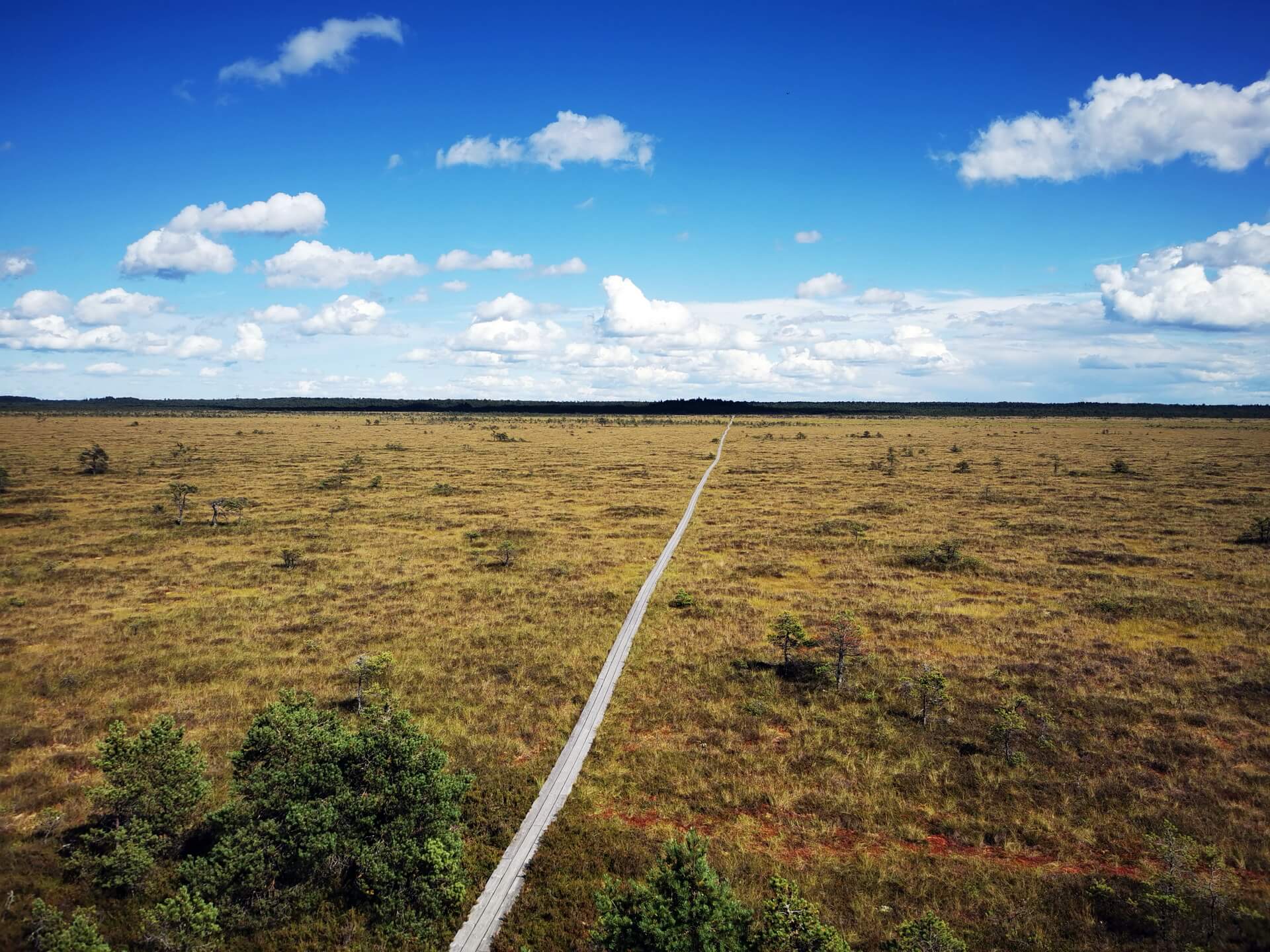
A healthy bog has few tall trees because the peat is acidic, waterlogged, and lacks basic nutrients. If you see a dense forest, the bog is likely degraded.
People often use words like wetland, marsh, swamp, and bog interchangeably. They are not. If you want the classic Estonian landscape, you are looking for a raised bog. These ecosystems are fed almost entirely by rainwater.
Over thousands of years, layers of peat build up until the centre rises higher than the edges. The peat makes the water acidic, and small pools are scattered across the surface. Look closely at the moss along the boardwalk: because the peat lacks basic nutrients, you will spot round-leaved sundew (Drosera rotundifolia) – tiny carnivorous plants that trap and digest insects on their sticky leaves.
Important rule: You cannot simply step off the wooden planks to explore this moss closer. Walking on the fragile sphagnum damages the ecosystem and is strictly forbidden. If you want the experience of walking directly on the open peat, you must wear specialized weight-distributing footwear. The most pragmatic way to do this is to book a Guided Bog-Shoe Hiking Tour which provides the gear and legal access to off-trail areas.
Where to Walk Estonian Bog Trails
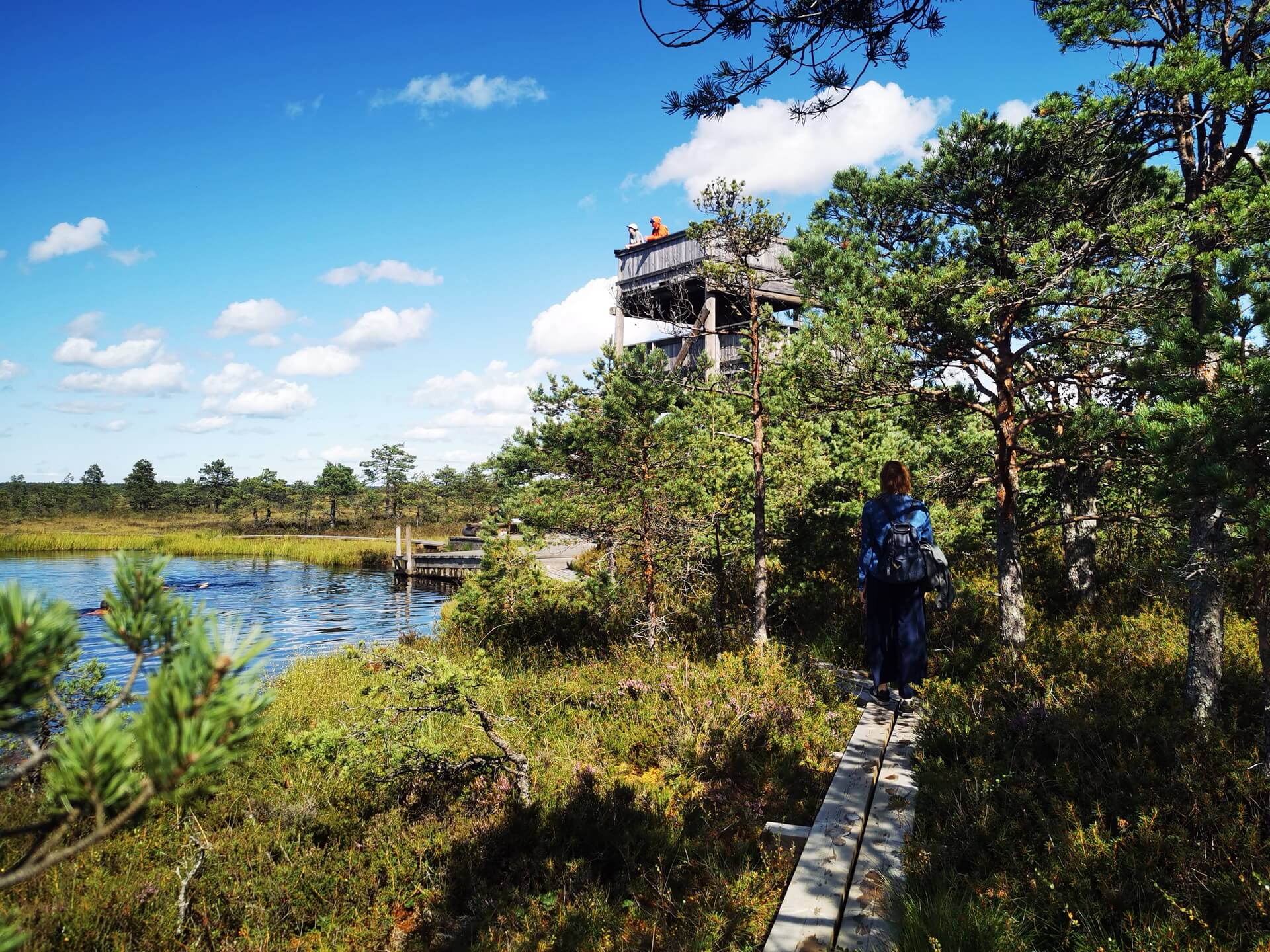
Without a watchtower, you will not grasp the scale. From the ground, a bog just looks like a flat field of moss.
Estonia has dozens of maintained boardwalk routes, but navigation requires precision. You cannot simply pull over on the side of the road and walk into a wetland – the peat is impassable without wooden planks. Every route must begin at an official trailhead equipped with a car park and information boards.
Before setting off, bookmark the official forestry website RMK and download the RMK Loodusega koos mobile app. The app works in English, gives you exact trailhead GPS coordinates, and provides offline maps – an absolute necessity when your signal drops in the middle of a dense pine forest.
Viru Raba (Lahemaa National Park)
Distance: ~6 km | Watchtower: Yes | Swimming ladders: Yes
- Best for: First-timers and quick day trips from Tallinn.
- My take: The most accessible route in the country. It delivers the classic landscape – pools, an observation tower, and safe swimming – but you will share the boardwalk with tour groups and families.
- Trailhead & Navigation: Search for Viru raba parkla on the Tallinn – Narva highway.
- Getting there: Direct regional buses run from Tallinn to the Viru raba stop (check peatus.ee). If navigating rural bus timetables is not for you, wrap this into the Estonian Countryside and Lahemaa Day Trip directly from Tallinn.
Marimetsa Raba (Lääne County)
Distance: ~9 km | Watchtower: Yes | Swimming ladders: Yes
- Best for: The ultimate wild swimming experience and wide horizons without the crowds.
- The reality: It offers arguably the best peat pool swimming in the country, but you have to earn it. The boardwalk does not start at the car park; you face a monotonous 4 km walk through fields and dense forest just to reach the edge of the wetland.
- Trailhead & Navigation: Set your navigator strictly to Marimetsa matkaraja parkla near Risti.
- Getting there: Difficult without a car. Direct buses run from Tallinn to the Risti stop (they are usually the ones heading to Haapsalu). It is even easier to reach by bus if you are already staying in Haapsalu itself. However, from the Risti stop, you still must walk 1.5 km to the trailhead, meaning your total walking distance for the day will easily hit 12 – 15 km.
Kakerdaja Raba (Järva County)
Distance: ~7 km | Watchtower: No | Swimming ladders: No (Lake swim)
- Best for: Early risers, birdwatchers, and wide, sweeping landscapes.
- The reality: A long wooden path cutting straight across the open moss with Lake Kakerdaja in the middle. The lake is known for its breeding black-throated loons, though spotting them is notoriously difficult.
- Trailhead & Navigation: The trail has two entry points, but the northern start at RMK Noku lõkkekoht is the better option.
- Getting there: Effortless by car (roughly an hour from Tallinn). If you do not drive, your only alternative is to take a bicycle on the Elron train from Tallinn to Aegviidu station, then ride 18 – 20 km along quiet roads to the Noku entrance.
Selisoo (Ida-Viru County)
Distance: ~4 km | Watchtower: No | Swimming ladders: No
- Best for: Photography and quiet reflection.
- My take: A shifting, quiet landscape with dozens of small peat pools and none of the crowds found at Viru. You lose the observation tower, but you get uninterrupted solitude.
- Trailhead & Navigation: Selisoo matkaraja algus (or Seli järve lõkkekoht for the southern access).
- Getting there: Effortless by car near the Jõhvi – Tartu highway. By bus, it only makes sense from Eastern Estonia: take a regional bus from Jõhvi to the Estonia kaevandus stop, then walk down the dirt road to the forest entrance.
Mukri Raba (Rapla County)
Distance: ~2.5 km | Watchtower: Yes | Swimming ladders: Yes
- Best for: Maximum return on minimal walking effort.
- The reality: A short loop that delivers all the essentials: a sturdy watchtower, wide vistas, and Lake Mukri equipped with a metal ladder.
- Trailhead & Navigation: Navigate directly to Mukri raba lõkkeplats.
- Getting there: Car only. A straightforward 1.5-hour drive south of Tallinn. Attempting rural buses here turns an easy stroll into a multi-hour logistical headache.
Wild Swimming in Estonia: Peat Bogs and Lakes
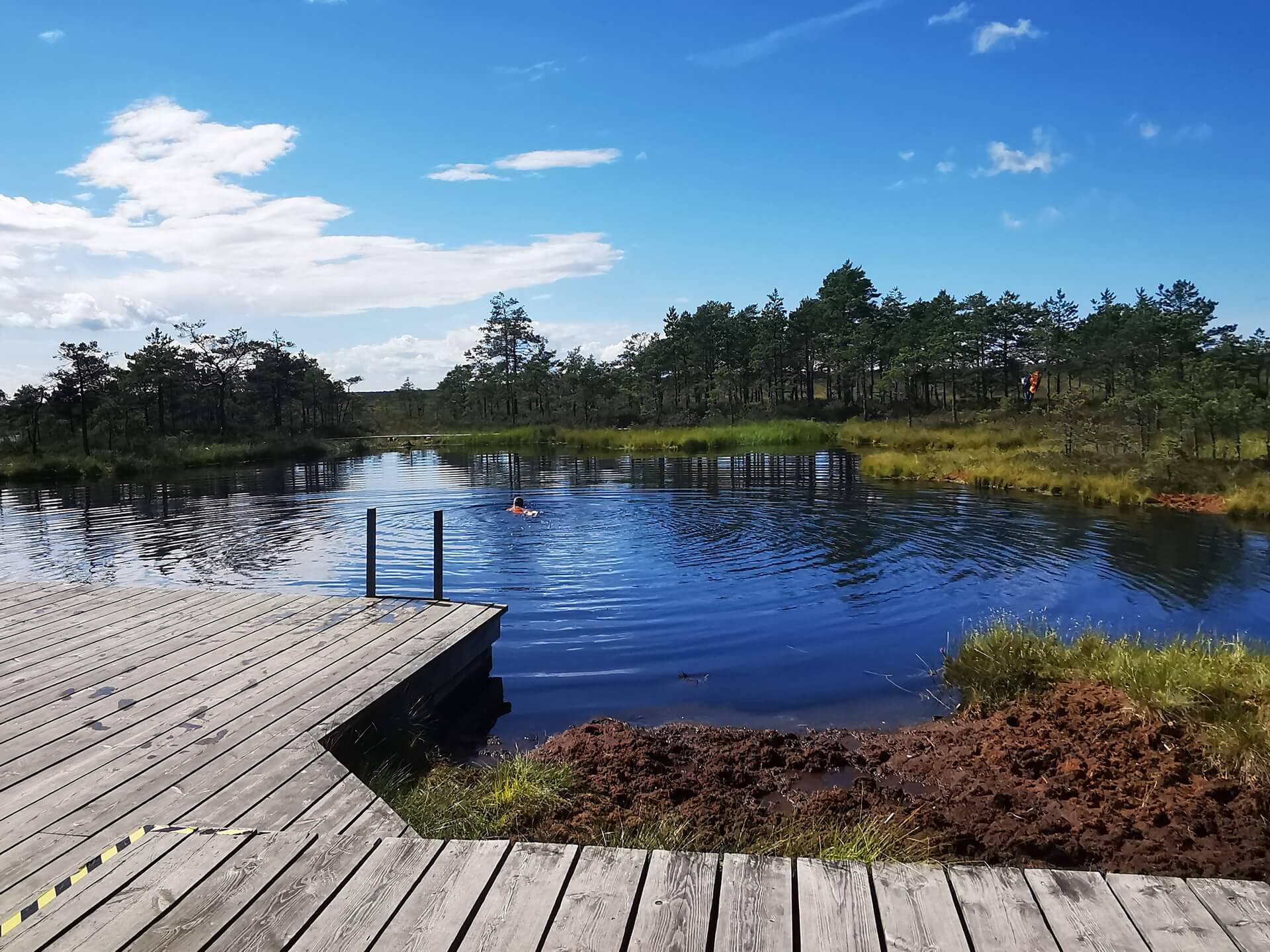
A metal ladder is a luxury. Without it, hauling your wet body back onto the slippery planks is a serious workout.
Can you swim in a bog? Yes. Locals start swimming here as soon as the ice melts.
Water Quality and Temperature Traps
The water is dark brown from dissolved organic matter and humic acids. It looks like black tea and feels very different from ordinary lake water. Because the acidic peat acts as a natural filter, the water is actually remarkably clean – so clean that you will sometimes see local guides drinking straight from the pools. I have tried it myself, but pragmatically, you are better off sticking to the water bottle in your backpack.
One practical warning: the surface might feel pleasantly warm in July, but drop your legs deeper and you will hit much colder water.
Getting In and Out of a Bog Pool
The important thing to understand is that bog pools have no shore. There is no beach and no shallow edge to wade into. The water simply drops off from the floating moss mat. You do not walk into the water; you step down directly from the boardwalk.
There are no changing cabins, and on the larger bogs, not even a shrub to hide behind. You strip down right on the planks. If there are two of you, take turns going into the water – just in case someone needs a hand hauling themselves back onto the slippery wood.
Best Time to Visit and What to Pack
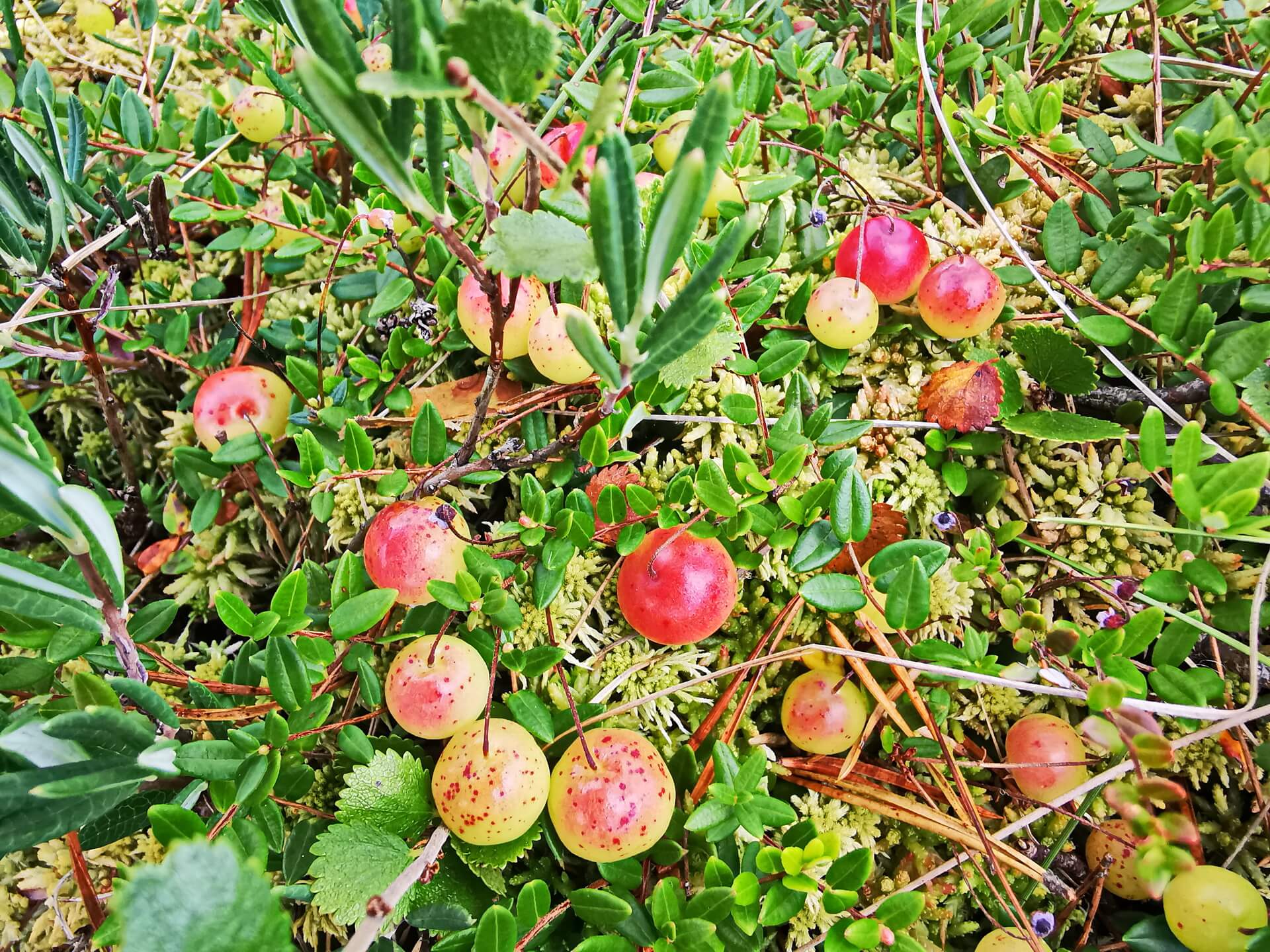
Foraging is legal in most Estonian forests and bogs, provided you are not in a restricted nature reserve zone. You can often eat the cranberries right off the moss.
Timing your visit dictates whether you get an incredible experience or a miserable slog.
- Summer: June brings blooming local orchids right in the moss — keep an eye out for the early marsh orchid (Dactylorhiza incarnata). Cloudberries ripen fast and must be picked in early-to-mid July. By August, bog bilberries take over the trail edges, and swimming conditions are optimal.
- Autumn: The vegetation turns vivid shades of red, rust, and yellow. Cranberries ripen across the sphagnum hummocks in September and October.
- Winter: A thick layer of snow turns the landscape into a high-contrast, minimalist photograph. March is often excellent for snowshoeing across the frozen peat, provided the ice is thick enough.
- The Worst Time: April and November. When the spring thaw floods the trails, or when the late-autumn skies go permanently grey, the landscape looks dead.
What to pack: Heavy hiking boots are a mistake in summer. You are walking on flat wooden planks, not scrambling over alpine rocks; heavy boots will just make your feet sweat. Any comfortable walking shoe works in the afternoon – I usually wear Keen sneakers or sandals.
However, there is a catch. In a particularly rainy year, the water level rises and completely submerges sections of the wooden boardwalk. When that happens, your choices are binary: take off your shoes and wade barefoot, or wear tall rubber wellies. If you go at dawn, heavy morning dew on the moss will soak normal trainers in minutes, making Gore-Tex trail runners the smartest choice.
Safety, Snakes, and Elusive Wildlife
The real hazard is not getting lost. It is losing your footing.
Do not expect a nature documentary. Animals are smart enough to stay away from the wooden trails during the day. If you want to see a common crane, an elk, or a black grouse, you must do exactly what local professional photographers do: hike in before dawn, sit in a camouflage hide, and wait in silence for hours. During a normal afternoon hike, you will mostly see dragonflies, frogs, and other people.
As for reptiles, Estonia is home to the common European adder (Vipera berus). On cool, sunny mornings, you may find them on the bare wooden boardwalk absorbing heat. Keep your eyes on the planks ahead of you. They almost always slide off into the moss as soon as they feel the vibrations of your footsteps, but do not step on them.
What to Avoid (Unless You Are in a Hurry)
Do not simply follow the nearest pin on a map. To get the actual experience, check two things on satellite view: an open horizon without tall trees and a network of peat pools. These are the hallmarks of a classic Estonian bog – and not every trail delivers them.
Take Sõõriksoo loodusrada, for example. It is easy to reach by train and perfectly fine for a short local walk, but the path runs mostly through dense marsh tea scrub rather than open wetland. If you want the minimalist aesthetic you see in the photographs, it will feel underwhelming.
Pääsküla Raba in Tallinn has a similar problem. Technically, it is a raised bog, but decades of drainage have altered the ecosystem, and today it is largely overgrown with pine thickets. You will spend most of your time walking through trees. Let’s be pragmatic: if you have a flight out of Tallinn Airport in three hours, Pääsküla is a perfectly reasonable compromise. Just do not expect the wide, open horizons of a healthy wetland.
What You Need to Know Before You Go
Can you swim in Estonian peat bogs?
Yes. The peat-filtered water is exceptionally clean and naturally acidic. However, understand the mechanics: the pools have no shallow edges or beaches. You step directly into deep, dark water straight from the wooden boardwalk. If there is no metal ladder, getting back out requires solid core strength.
How do I get there without a car?
With careful planning. For trails like Viru, take a regional bus from Tallinn (check peatus.ee). The real trap is the return journey – miss the last rural bus, and a Bolt back to Tallinn will easily cost €60 – €80, assuming a driver even accepts the trip. For trails further out, expect to walk or cycle several kilometres from the nearest train station.
Are the bogs swarming with mosquitoes and ticks?
On the open moss during a breezy day, mosquitoes are rare. But the damp pine forests leading to the boardwalks are a different story. Bring repellent. Ticks are endemic in Estonia, so a routine tick check after your hike is mandatory. For more details, read my guide on surviving mosquito season in Estonia.
Can I walk directly on the moss?
No. Stepping off the boardwalk damages the fragile ecosystem and is strictly forbidden in protected reserves. To safely walk on the moss, you must wear specific footwear and book a guided bog-shoe hiking tour.
What about bicycles, toilets, and drones?
Bicycles: Not allowed; the planks are too narrow.
Toilets: There are no facilities on the trail, only basic dry outhouses at the car parks.
Drones: Check local regulations, as many bogs are strict nature reserves with seasonal no-fly zones.

