








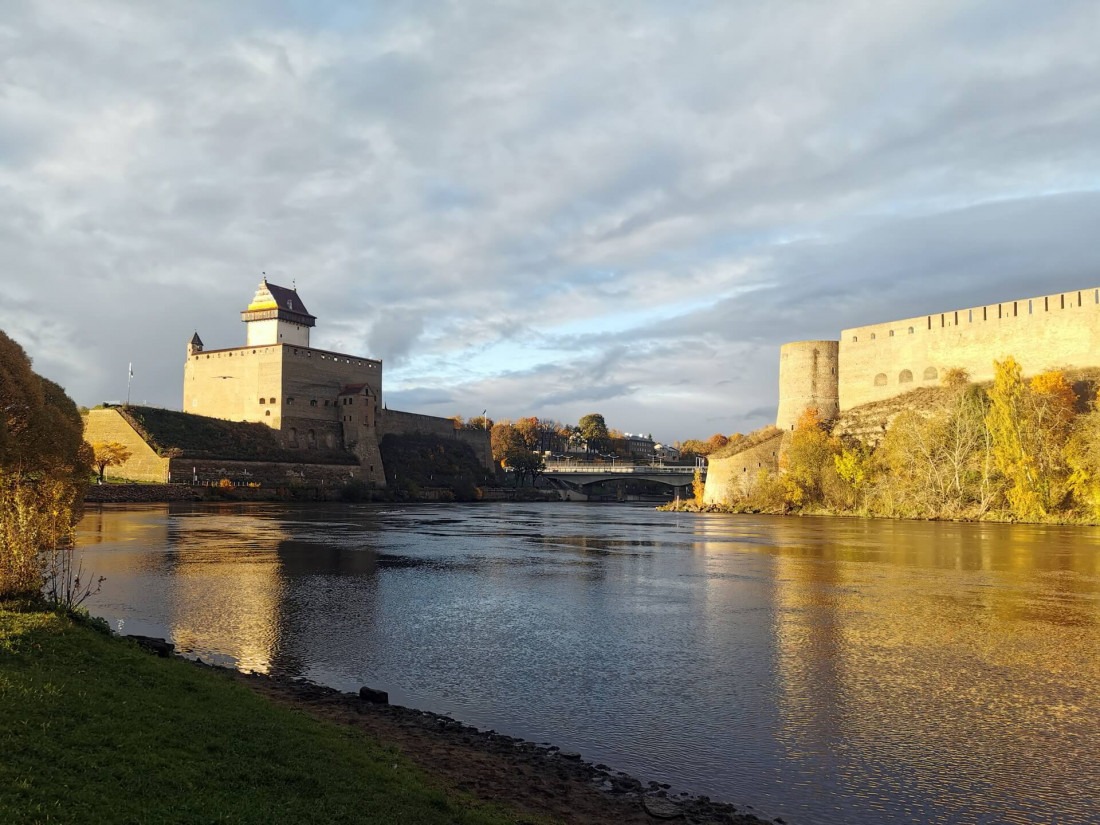
Stand on the riverbank in central Narva, and the first thing that hits you is the sheer proximity. This is not a vague, distant horizon line. The Russian Federation is roughly 150 metres away across a stretch of dark, fast-moving water.
On the Estonian side, you have the 13th-century Hermann Castle. Directly opposite, practically close enough to shout across, sits the immense, brooding stone wall of the Russian Ivangorod Fortress. It is the most literal architectural standoff in Europe – two medieval military machines staring each other down across a geographic bottleneck.
Yet, the bizarre part of visiting Narva is how aggressively normal the immediate surroundings feel. If you are expecting a tense, militarised zone, you will be disappointed.
In Brief:
- Narva: The place for fortress-to-fortress border views. Give it 4 to 5 hours on the ground. An easy day trip from Tallinn.
- Narva-Jõesuu: A seaside resort north of Narva, where the Russian side — just a dark line of trees — remains in plain sight across the river. Best for a slower pace and an overnight stay.
- Transit from Tallinn: Direct train (2.5 hours) or bus (3h 15m) to Narva. Narva-Jõesuu requires a local transfer via Narva or Sillamäe.
- The Golden Rule: You are in Estonia. There are no document checks or passport controls on the route from Tallinn, and you do not need any special permits to visit Narva’s riverfront and public viewpoints.
Staring Down the River Standoff
When you walk down to the modern concrete river promenade, the disconnect between geography and daily life becomes entirely surreal. Locals jog past you and sit on benches drinking coffee, while right across the water, you can clearly see the peeling paint on Soviet-era apartment blocks and private houses with satellite dishes.
The only physical connection between the two worlds is the Friendship Bridge. It serves as the Narva-1 pedestrian checkpoint. No vehicles cross here anymore – the Russian side closed the checkpoint to road traffic, leaving only a pedestrian corridor. Since June 2026, the crossing operates only from 07:00 to 19:00.
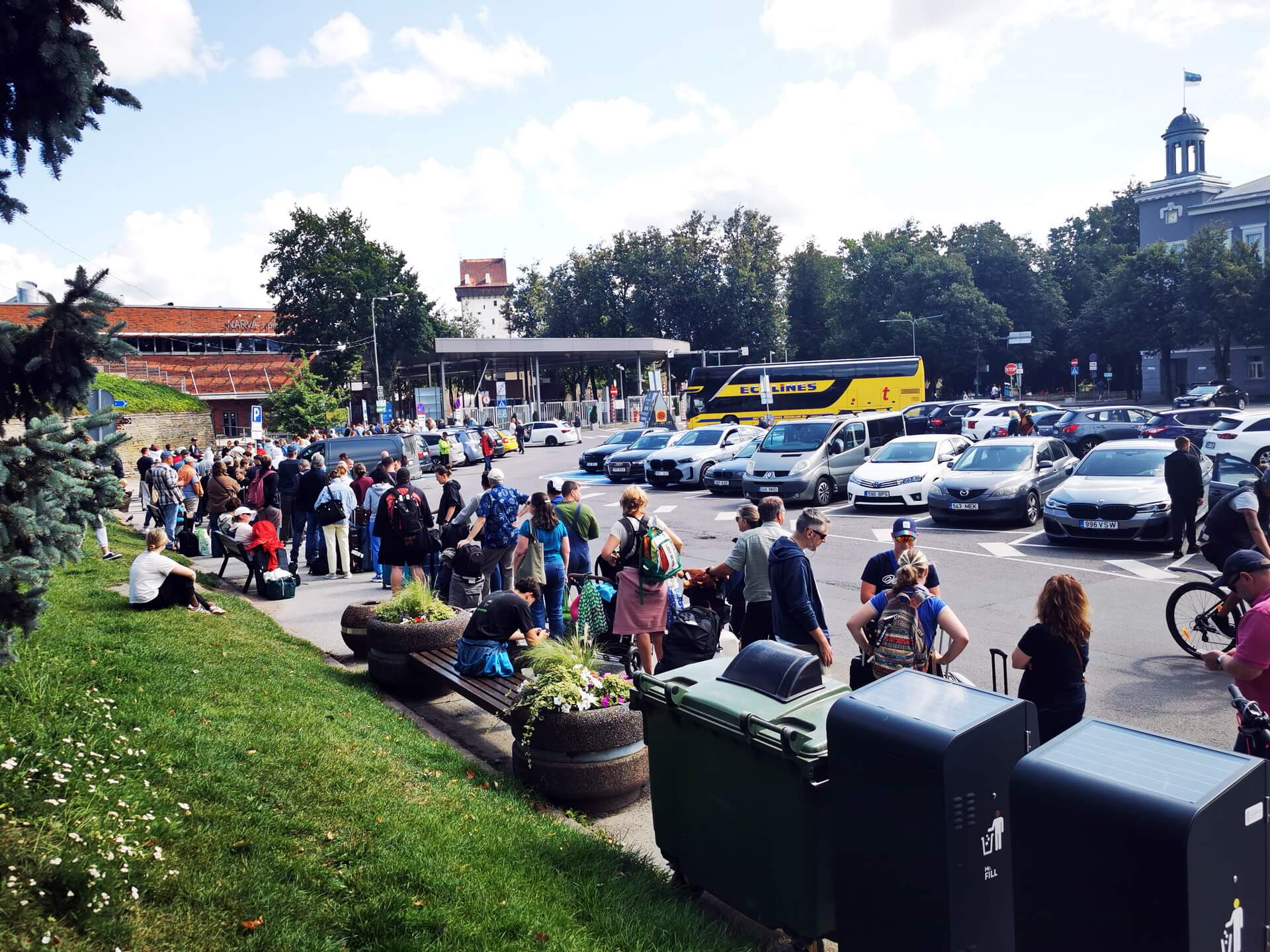
With the bridge closed to vehicles, long-distance bus passengers are now forced to navigate the geopolitical divide on foot, turning the border square into a permanent outdoor waiting room.
The tension of a closed continent is reduced to an exhausting, mundane ritual. You will see an eclectic queue of people – the elderly, families with children – waiting for hours, sometimes an entire day. Many bring folding chairs.
Minibuses and coaches drop them off on the Estonian side, they drag their suitcases across the asphalt bridge on foot, and another bus waits to collect them on the Russian side. It is a stark reminder that this is not just a river, but the rigid eastern edge of the European Union.
Navigating a Route Through Concrete and Rubble
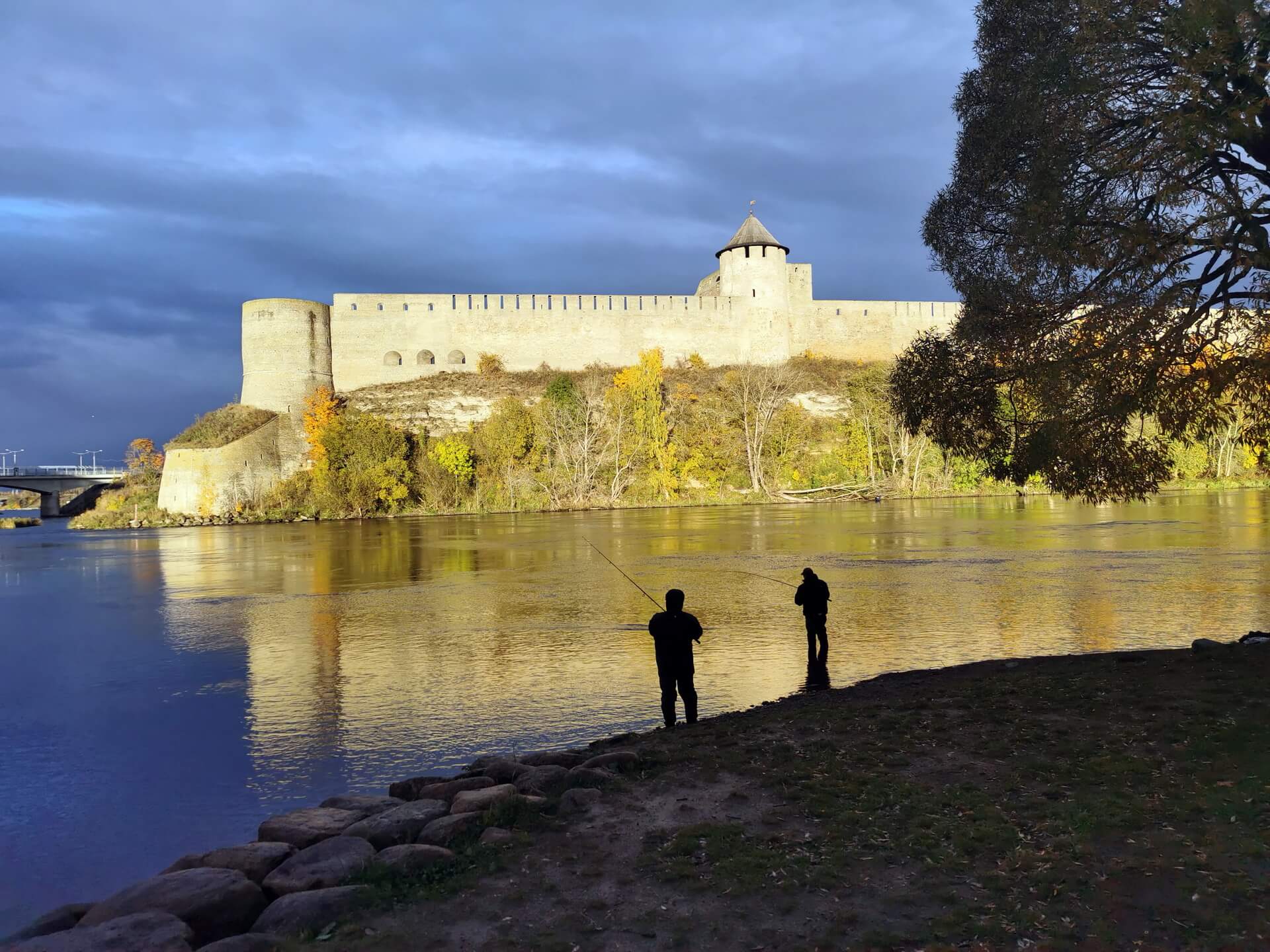
Casting a line towards the Russian Federation. The physical proximity of the imposing Ivangorod Fortress makes the rigid EU border feel absurdly small against the everyday routine of local fishermen.
Dodging the 50-Euro Roaming Trap
Russian cell towers frequently overpower local EU networks at the riverbank. If your phone silently jumps to a Russian carrier, you will be hit with massive non-EU roaming charges. Before walking down, turn off ‘Automatic’ network selection and lock your phone to Telia, Elisa, or Tele2.
The entire route is a compact 2.5-kilometre walk that takes roughly 1.5 to 2 hours at a relaxed pace, including time to stop and take photos. It is entirely paved. To find the best vantage points without getting stuck in residential dead ends, follow this sequence:
First Stop: The Checkpoint and Castle
Start at Peetri plats (Petrovskaya Square), right next to the border crossing. From here, it is a one or two-minute walk into the Narva Castle courtyard for an elevated, unobstructed look at Ivangorod.
Chasing the Five-Kroon Vista
Exit the castle and walk towards the adjacent Paul Keres square, but step just off it onto Igor Grafovi street. There is a dedicated observation platform here framing both fortresses. If you remember Estonia before the euro, this is the exact vista that was printed on the back of the 5-kroon banknote before Estonia adopted the euro in 2011.
Joaorg Island Between Two Worlds
Take the stairs down to the water and cross the small metal bridge onto the Joaorg recreation area. From this island in the middle of the river, you get a perfect vantage point of both massive stone fortresses in a single frame.
The Town Hall and Narva’s Architectural Ghost
Follow the paved promenade north, passing directly under the Friendship Bridge, before heading up the slope into the city to reach the Narva Town Hall (Raekoda).
Narva was once known as the baroque pearl of the Baltic Sea, but the historic centre was completely flattened by Soviet bombers in 1944. Today, the restored Town Hall sits in an awkward space among Soviet apartment blocks, alongside Narva College – a building designed as a negative-space architectural ghost of the former Stock Exchange to highlight what was erased.
The Kreenholm Question: Is It Worth It?
Tourism brochures will push you to visit the Kreenholm Manufacturing Company – a colossal, abandoned 19th-century textile mill. It is impressive, but for independent travellers, it is a logistical pain. You cannot just walk in; access requires syncing with specific guided tours that will swallow a large chunk of your afternoon.
If your goal is simply to see the border, skip Kreenholm entirely. If you genuinely want to see the industrial ruins but cannot be bothered with the local transit puzzle, outsource it. This From Tallinn: Narva and “A View of Russia” Day Trip covers the riverfront and guarantees Kreenholm access without the scheduling headache.
Narva-Jõesuu: Where the Border Hits the Sand
If Narva is defined by stone and concrete, Narva-Jõesuu is where the border dissolves into pine needles and sea water. Located a 25-minute drive north towards the sea, this is where the Narva River finally empties into the Gulf of Finland.
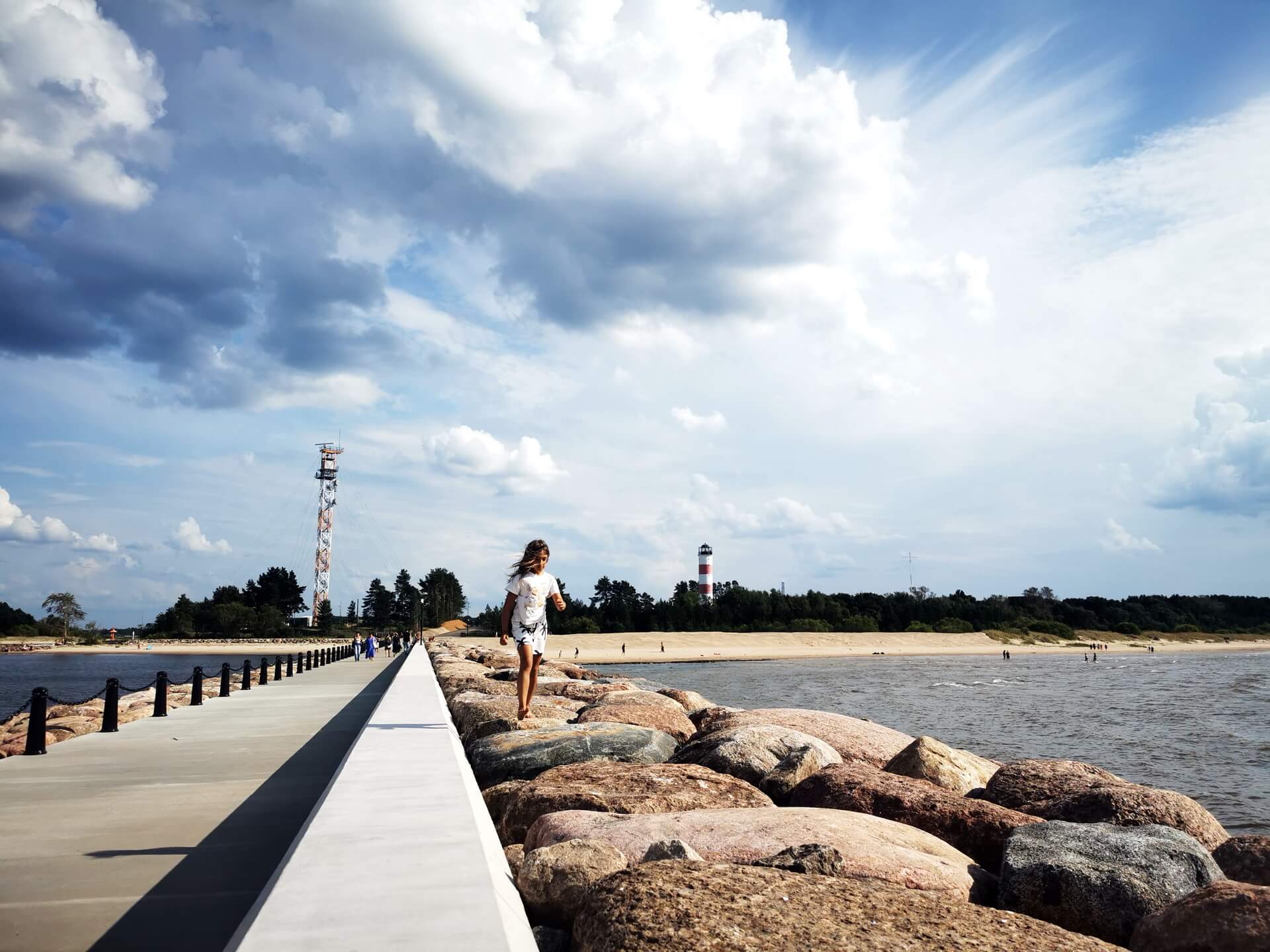
Walking into the open sea – as you stroll along the 300-metre stone mole, the vast expanse of the Gulf of Finland opens up ahead, while the Russian coastline stays in plain sight to your right.
Historically a small fishing village that evolved into a summer retreat, the town is now a quiet mix of stone and wooden villas, modern spa hotels, and dense pine forest. The atmosphere is entirely different here. There is no Russian town opposite you. Across the river mouth, the Russian shore is just a dark tree line.
To get a physical sense of the edge, walk out onto the newly rebuilt mole – a stone pier extending over 300 metres directly into the Gulf. Exploring this stretch involves a mix of wooden boardwalks, soft beach sand, and forest trails. It is a flat, breezy 1.5 to 3-kilometre stroll from the main spa hotels, but if you want to skip the walk, take a local bus to the Coop stop – the pier is barely 200 metres away from there.
Right next to the stone pier stands a striped border pole. It is the definitive marker of the land border before it gives way to the sea.
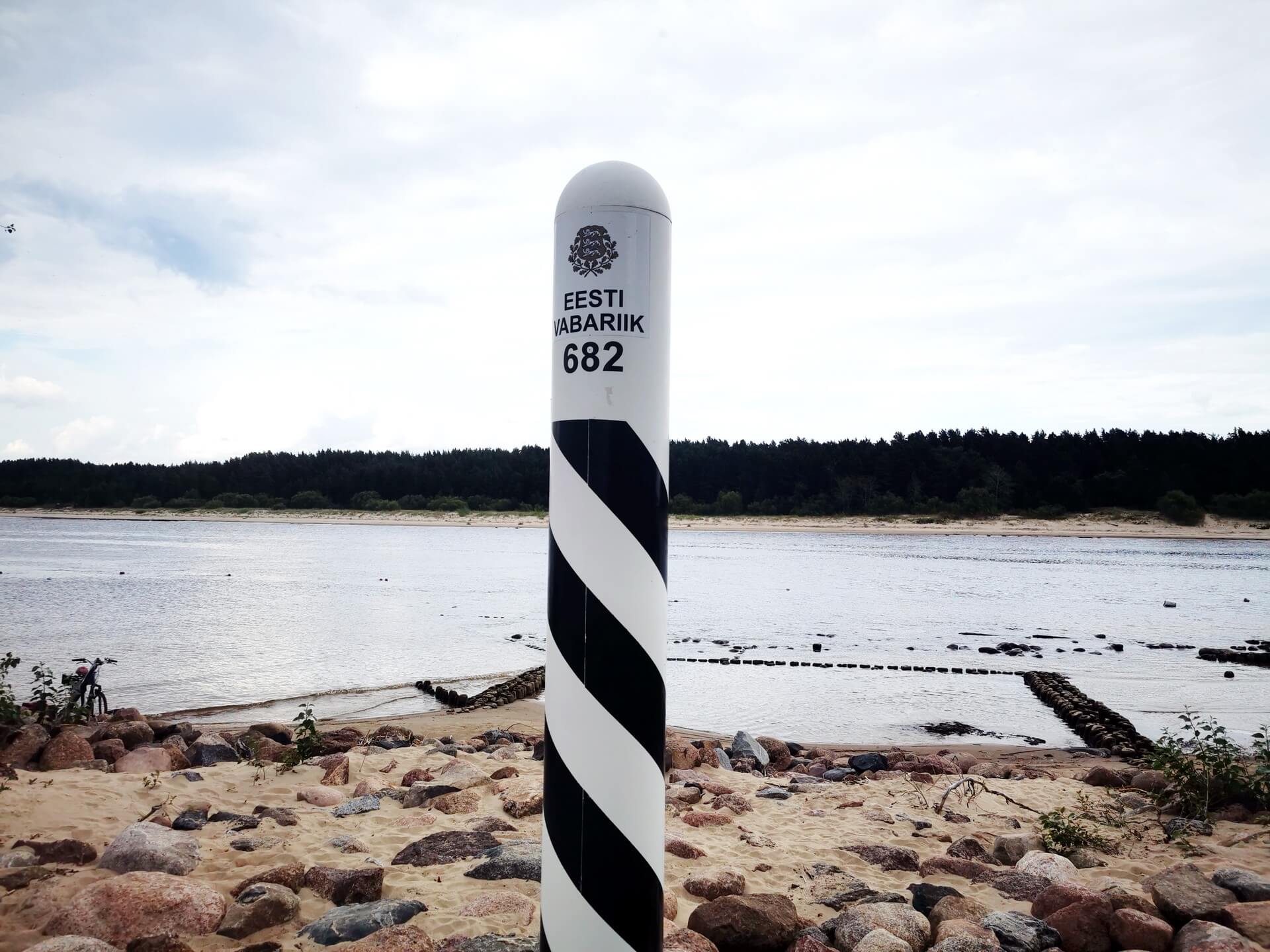
Acting as the final physical marker of the Estonian border, this striped pillar stands stark against the backdrop of the Narva River mouth and the Russian coastline.
A short walk away is the 30.3-metre red-and-white lighthouse, built in 1957. During the summer (typically Thursday to Sunday, 5 euros entry), you can climb it for an expansive view of the Baltic coast and the lively, tourist-filled beaches below.
Where to Stay in Narva-Jõesuu
If you are staying overnight, you are essentially sleeping on the sandy edge of the European Union. The accommodation here splits cleanly between massive wellness factories and quiet, independent apartments.
Meresuu Spa & Hotel – One of the two heavy wellness monoliths on the coast. Reliable, heavily booked, and right by the pine line. Expect predictable infrastructure, large pools, and inevitable family crowds oblivious to the border just up the beach.
Noorus SPA Hotel – Meresuu’s direct large-scale rival. Slightly flashier, built on the exact same mega-spa formula. Choose whichever has better pricing for your dates; operationally, they occupy the same niche.
Liivarand Hotel – Located further toward the quieter edge of town. A more low-key, relaxed choice if you want to stay near the coast without dealing with the chaotic bathrobe traffic of the main resorts.
Merepargi ApartHotel & Cafe and Velvet Loft Apartment – Practical alternatives if you want to bypass the wellness industry entirely, offering independent setups and private loft spaces for a much quieter stay.
Practicalities: Language and Dining
Narva is the most Russian-speaking city in Estonia, so you will hear very little Estonian here. Russian is the default everyday language, though English works perfectly fine at major tourist spots.
In Narva, Bublik is the workhorse for coffee and dumplings. Valge Kõrvits (White Pumpkin) is your best bet for a proper, sit-down dinner near the Town Hall.
Out on the coast in Narva-Jõesuu, you have two excellent, contrasting options. Meretare sits directly on the sandy beach, making it the perfect spot to watch the sunset drop straight into the sea. If you want something unconventional, look for the plain roadside exterior of Franzia. It offers uncompromising border-town cooking, featuring local lamprey and heavy flavours.
How to Get There (and Away)
Getting east from Tallinn is simple once you know how the local transport network operates. If you are still planning your time in the capital, have a look at my Tallinn Unfiltered: A Pragmatic Guide to the Actual City to get the right footing there first.
Tallinn to Narva: Train vs. Bus
By Train: Elron runs the bright orange trains from Tallinn’s Balti Jaam. The trip takes about 2.5 hours. If you take a morning train, you can usually grab a seat in Standard Class without issue. However, if you want certainty – especially on a Friday evening – pay the extra few euros for First Class to guarantee a designated seat with a table and a plug socket.
By Bus: All long-distance coaches leave Tallinn Bus Station (Tallinna Bussijaam) almost every hour. It takes around 3 hours and 15 minutes. Book via tpilet.ee.
The Bus Stop Hack: Do not ride the bus to the final stop in Narva. Get off at Peetri plats. This drops you right at the castle gates. When heading back to Tallinn, you must board at the main bus terminal (Narva bussijaam) next to the railway tracks.
Getting to Narva-Jõesuu
There are no direct long-distance buses from Tallinn to the beach. You have three main options:
Via Narva (Bus): Catch local county bus No. 31 from the Narva station. You can check the exact departure times on peatus.ee. The ride takes about 25 to 30 minutes. You do not need a paper ticket – just tap a standard contactless bank card at the machine next to the driver, or swipe your green Tallinn public transport card (Ühiskaart).
Via Narva (Taxi/Bolt): Use the Bolt app to order a ride. A car from Narva to Narva-Jõesuu will cost around 15 to 20 euros during the day, and more in the evening.
Bypassing Narva With the Sillamäe Hack
If you want to skip Narva entirely, take any long-distance bus from Tallinn and get off early at Sillamäe. From there, catch a local bus straight to Narva-Jõesuu. It saves you a 40-minute geographical detour.
Mind the Connection Gap: The Tallinn bus leaves you at the highway stop (Sillamäe bussijaam). You will need to walk about 3 to 4 minutes to either the Sõpruse or Turg stops to catch the local connection to the beach. Check the schedule on peatus.ee. Do not book a tight connection assuming you can just step off one bus and onto another.
What You Need to Know Before You Go
Is Narva safe?
Yes. It is a standard EU city. The border is heavily controlled; just stay on the paved public paths and do not ignore the warning signs.
Can I accidentally cross the border?
Not under normal circumstances, as the river is the boundary. Do not attempt to walk onto the ice in winter. In fact, a recurring local headache is off-leash dogs wandering across the frozen river from Russia into Estonia, triggering a massive bureaucratic nightmare involving passports and vaccination records to send them back. Keep your pets on a leash.
Can I fly a drone to get a better photo of the fortresses?
Absolutely not. The Narva River is a strictly controlled border zone. Flying a drone here without clearance from the Estonian Police and Border Guard Board will result in heavy fines, and the drone will likely be confiscated or jammed. Keep it in your bag.
Can I visit Russia for the afternoon?
No. Entering Russia requires a pre-arranged visa. Standing on the Estonian side requires zero paperwork – you are just standing in the Schengen zone.
What about Vasknarva?
Vasknarva is further south, where the river begins. There is no checkpoint, you cannot cross, and getting there without a car is an absolute headache. Skip it.

